
The Architectural Blueprint for a High-Trust Nation
Note
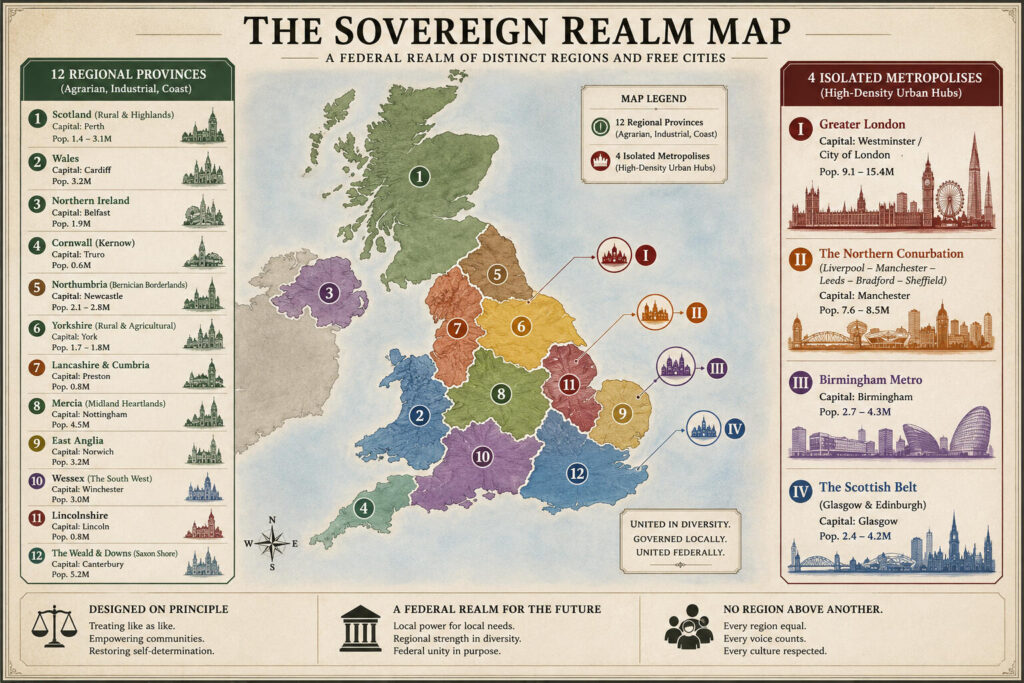
The images in this article were made with AI as I’m not a good enough artist or cartographer. Unfortunately that means the exact locations aren’t always that accurate, but by refering to the text you should be able to figure out where things should be.
In The Great Devolution Deception, we diagnosed the fatal defect of the modern British state: it is suffering from terminal, institutional decay brought on by a pathological, thousand-year habit of hyper-centralization. We exposed modern “devolution” proposals championed by metropolitan figures like Andy Burnham for what they truly are: administrative parlor tricks and cosmetic relocations of executive desks that preserve the central state’s financial and administrative monopoly while delegating only the responsibility for failure.
It is easy enough to diagnose a rotting house. It is far harder, and far more vital, to lay down the blueprints for the new one.
The British public already understands, with a weary and visceral certainty, that the root cause of our national decline is Westminster. They may not express it in the dry terminology of constitutional theory, but they feel its consequences every day, in the cancellation of regional train lines by a broken transport network, when a northern hospital ward loses funding from an underfunded NHS, in the shuttering of empty high streets, and every time a local council is forced to beg a Treasury bureaucrat for a grant to repair their own roads.
If we are serious about building a high-trust, federal United Kingdom that does not collapse under its own weight, we must stop begging Westminster to reform itself. We must systematically dismantle it, divide the levers of power according to the true nature of governance, and restore self-determination to the people.
This essay provides the concrete, structural alternative. It lays out the precise architectural, democratic, and economic mechanics required to dismantle the Westminster monopoly, isolate our parasitic metropolises, distribute the levers of state power across the soil of the island, and construct a high-trust, federal United Kingdom.
Part I: Dismantling the Engine of Centralization
To build a federal state, we must first clear away the ruins of the unitary one. The physical and constitutional concentration of absolute power in SW1 is an archaic anomaly that stifles the natural vitality of our regions. We do not need cosmetic renovations; we need a complete constitutional re-engineering of Parliament.
1. The Bicameral Transformation: Senate and Regional Parliaments
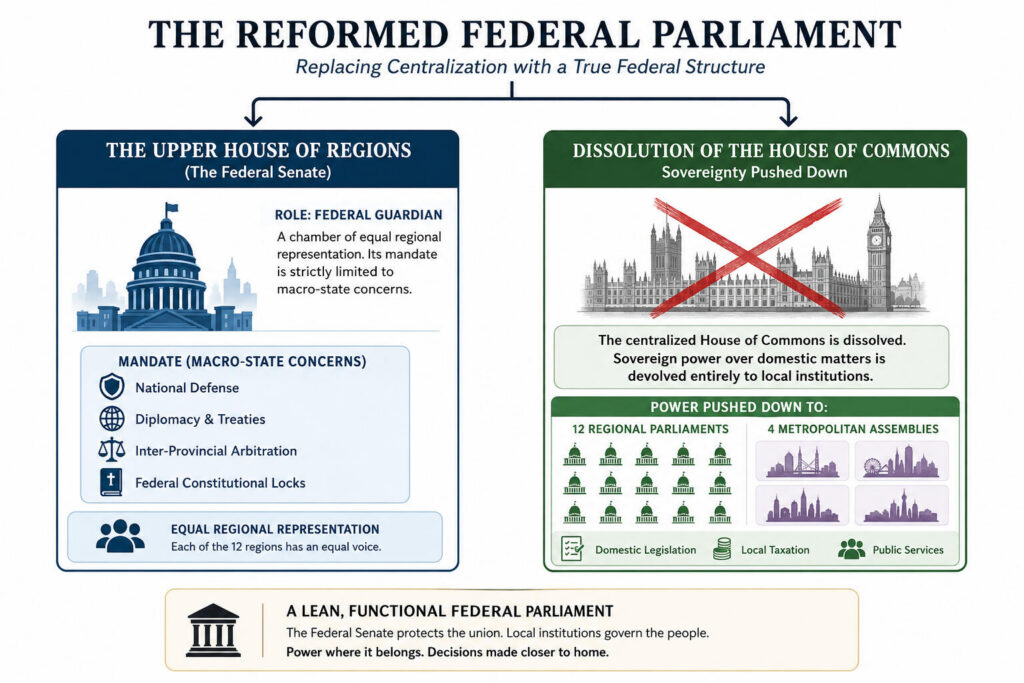
The existing bicameral system is broken beyond repair. The parliamentary apparatus – comprising an unrepresentative House of Commons and a bloated, unelected House of Lords – is structurally incapable of serving a modern, decentralized nation. We propose its total replacement, with a lean, functional, federal structure:
- The House of Lords is permanently abolished. In its place stands the Upper House of Regions – a true Federal Senate. This body will not serve as a retirement home for political donors, party loyalists, political cronies, or former ministers, but an assembly of regional representatives. It is an assembly directly elected by the public, from each of the twelve sovereign regions and four metropolitan city-states, with seat allocations distributed proportionally by population relative to the United Kingdom as a whole. While our regions are designed to balance economic and geographic scale, we explicitly reject artificial misrepresentation: rural Scotland or Cornwall cannot hold an identical vote tally to high-density London. The total number of seats should number no more than 150, far fewer than the current in either the House of Lords or the House of Commons, making it far more efficient, and capable of easily making representative decisions. Its remit is strictly legislative and defensive: it handles macro-state policy, including national defense, international treaty validation, inter-regional dispute arbitration, and the stewardship of federal constitutional locks. It possesses no authority to interfere in the internal domestic affairs of the individual provinces.
- The House of Commons as a centralized sovereign body is dissolved. The concept of Parliamentary Sovereignty – where 650 individuals in a single room in London hold absolute authority over every acre of the realm – is formally retired. Sovereign domestic authority is pushed down directly to the Twelve Regional Parliaments and Four Metropolitan Assemblies. Each region becomes the sole master of its internal taxation, housing, transport, healthcare, education, and civil law.
2. High-Trust Democratic Hygiene: Schulze STV
A decentralized state cannot functionally survive on a low-trust electoral system. The traditional First-Past-The-Post (FPTP) system is a winner-takes-all relic, an engine of hyper-centralization: it manufactures artificial, unchecked majorities from minority popular votes, entrenches two-party dominance, and disenfranchises millions of voters whose choices happen to lie outside designated “swing seats”. Conversely, pure closed-list Proportional Representation simply transfers absolute power to central party headquarters, allowing party bosses to hand-pick obedient backbenchers. Both systems on their own are left wide open to all manner of corruption, and you cannot trust a system that can be easily corrupted.
To restore democratic legitimacy, all regional and federal elections will utilize Schulze Single Transferable Vote (Schulze STV) method within multi-member constituencies. This ensures that every vote counts, proportional representation is achieved without party-list manipulation, and representatives are genuinely preferred by their electorates.
Schulze STV combines the ranked-choice fairness of traditional STV with advanced Condorcet voting algorithms. In practice, this means:
- No Wasted Votes: Voters rank candidates in order of preference (1, 2, 3, etc.). If a voter’s first choice has no chance of winning or already has more votes than needed to win, their vote is automatically transferred to their next preference.
- True Preference Matching: The Schulze algorithm evaluates pairwise comparisons between all candidates on the ballot, ensuring that the candidate who wins is the one preferred by an absolute majority when measured directly against every opponent.
- Elimination of Party Gerrymandering: Party bosses cannot dictate rankings. Independent candidates and regional parties compete on an entirely equal footing with established national movements, forcing representatives to earn the personal trust of their local electorate.
3. Constrained Mixed-Member Proportionality (MMP)
Reconciling the Value of Political Parties
We must be realistic about human nature and political history. Older and more traditional voters often distrust drastic electoral experiments; they prefer proven institutional structures. Political parties exist for a reason: Britain’s political culture is inherently tribal, and political parties—when properly constrained—are vital engines of statecraft. They hold institutional memory, train statesmen and stateswomen, maintain policy coherence across decades, and allow busy citizens to vote for a broad, reliable ideological banner without needing to study every micro-policy.
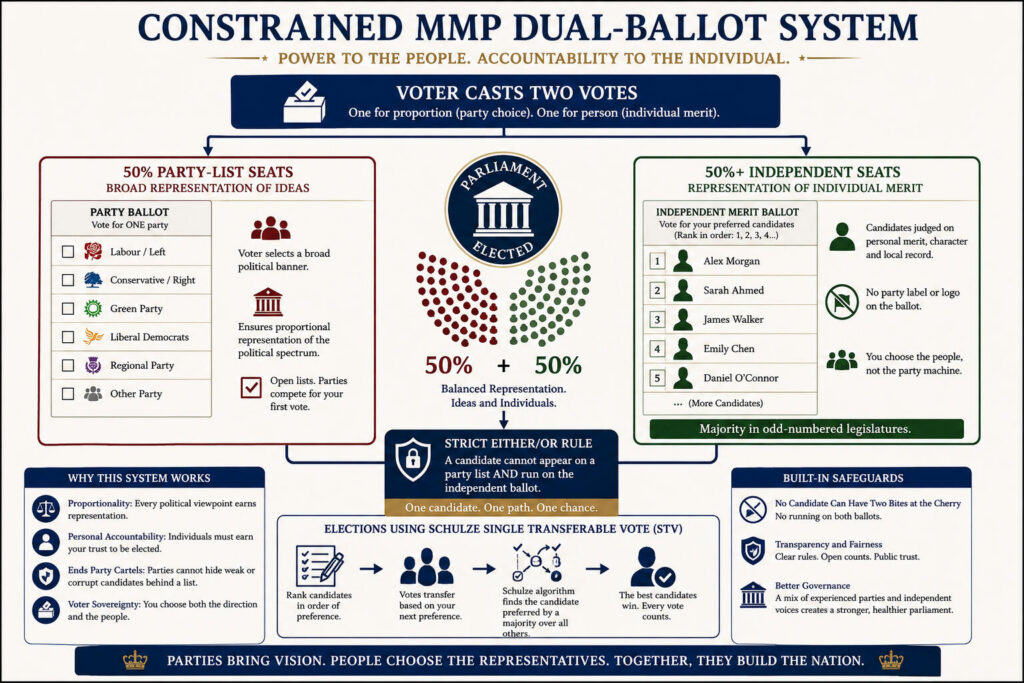
The problem in Britain is not that parties exist, but that they have captured the state. Our model brings parties to heel, forcing them to yield to the ultimate sovereignty of the people. To reconcile democratic representation with institutional wisdom, all regional and federal elections will utilize a Constrained Mixed-Member Proportional (MMP) system.
The Electoral Mechanics:
- The Dual Ballot: Citizens cast two votes. Fifty percent of parliament is selected from open party lists to ensure broad proportional representation across the political spectrum. The remaining seats (and the majority in odd-numbered legislatures) are designated for Independent Merit Candidates.
- The Independent Merit Ballot: On the independent portion of the ballot, no party affiliations or logos appear next to any name. Candidates are judged solely on their personal character, local community record, and individual platform. While a candidate may hold personal party membership, their party cannot shield or market them on this ballot.
- The Strict Either/Or Rule: A party has exactly one chance to get a candidate elected. A politician cannot run on a party list and simultaneously stand on the independent ballot. If a party puts forward a senior figure on the independent ballot and the public rejects them, they are out. Parties must earn every inch of their influence.
Furthermore, representation must be brought down to human scale. Power must be restored to local district councils and parish assemblies, giving communities direct control over their immediate environment. Where major strategic or ethical choices arise, binding direct democracy mechanisms (citizens’ initiatives and referenda) will be introduced.
4. Devolving Democracy to the Bedrock: Councils, Parishes, and Direct Directives
Democracy does not end at the regional parliament door. If we replace Westminster centralization with regional centralization in York, Cardiff, or Edinburgh, we have merely built smaller tyrannies. Power must be pushed down to the absolute bedrock of civil society: parish, town, and district assemblies.
Under this model:
- Hyper-Local Empowerment: Parish and town councils receive dedicated, non-negotiable shares of local property levies. They gain direct planning authority over local land use, community housing development, parish infrastructure maintenance, and public spaces. Decisions regarding a village green or a town high street will be made by the people who live within walking distance of them, not by planning officers in a distant regional office.
- Binding Direct Democracy: To prevent elected representatives from drifting into an insulated political caste, we introduce two permanent constitutional mechanisms:
- The Citizen’s Initiative: A petition signed by 10% of a region’s registered electorate automatically places a proposed law on the ballot for a binding public referendum.
- The Legislative Recall: If a representative votes in explicit violation of their election pledges or constitutional duties, a petition of 5% of their local constituents triggers an immediate recall election.
When representatives are subject to Schulze STV electoral accountability, continuous local consultation, the constant possibility of a binding citizen referendum, and the risk of a recall election the gap between the governing class and the governed evaporates. Politicians no longer have to spend fortunes on public opinion polling to guess what the people want; they know their constituents because they walk the same streets, shop in the same markets, and answer to them directly.
Part II: Mapping the Realm: Treating Like as Like
Ancient political philosophy teaches that justice consists of treating like things alike and unlike things differently. The fundamental tragedy of the unitary British state has been its relentless attempt to force wildly disparate geographies, economies, and cultures into a single, uniform administrative mould designed in London.
A hill-farming community in the Cumbrian fells has radically different needs, priorities, and rhythms of life than a financial trading sector in the City of London or an urban tech hub in Manchester. Forcing both under the exact same regulatory and financial regime starves the countryside and stifles the city. A sheep farmer in the Cumbrian fells does not need a skyscraper any more than a city trader in Manchester needs a cattle drive.
The Strategic Isolation of the Four Metropolises
Modern urban conurbations possess immense economic gravity. However, when high-density cities are allowed to dominate their administrative regions, they act as regional parasites. They suck in capital, educated youth, and infrastructure investment, leaving their surrounding rural and industrial hinterlands to rot as abandoned feeder zones.
The four great urban engine-rooms of Greater London, The Northern Conurbation (stretching from Liverpool and Manchester to Leeds and Bradford), Birmingham Metro, and The Scottish Belt (Glasgow and Edinburgh) have spent decades acting as regional parasites. Left uncontained, they suck the capital, youth, and political oxygen out of their surrounding countryside, creating secondary “mini-Londons” that replicate the very corruption we seek to destroy.
To solve this, we extract and isolate the four massive, urbanized conurbations of the island, creating Four Independent City-State Metropolises. By separating these four metropolises into self-governing, specialized City-States, we insulate the surrounding provinces from urban hegemony while allowing the cities the legislative freedom to manage high-density transit, international commerce, and technological innovation. I’ll list them in terms of size so we can see how they rank in importance for the UK as a whole:
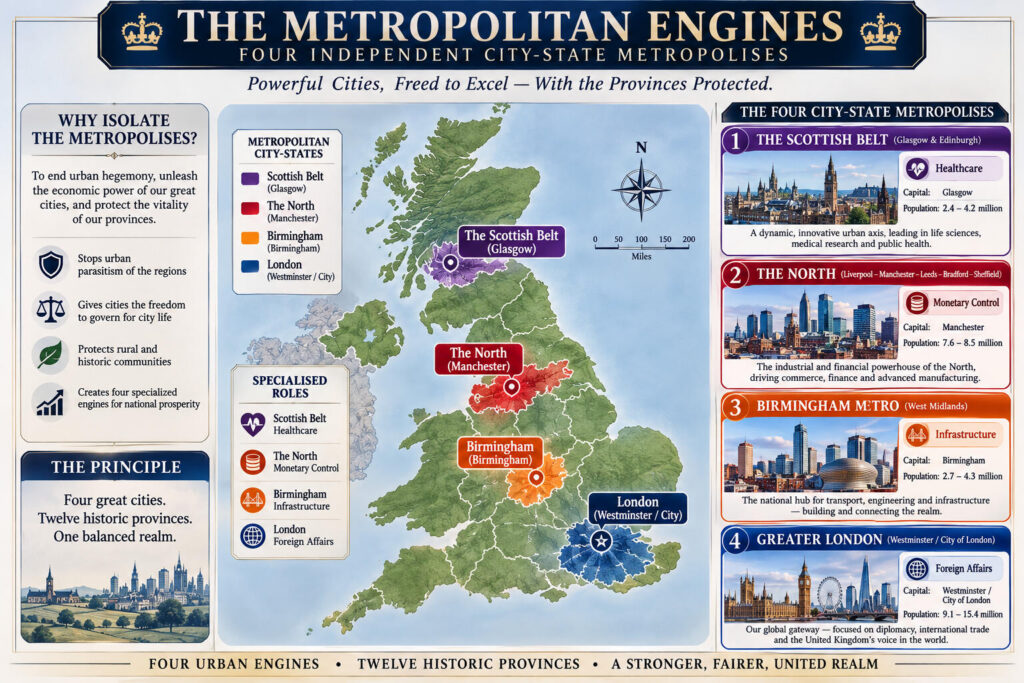
1. London (City-State)
Territory: The Metropolitan area of Greater London.
Federal Capital: Westminster / City of London. The historical capital of the city.
Population: 9.1 – 15.4 million.
Restricted to its urban footprint. Stripped of its administrative monopoly over the British Isles, London operates as a self-governing global commercial hub.
2. “The North” (Trans-Pennine Conurbation)
Territory: Urban belt from Liverpool through Manchester to Leeds-Bradford and Sheffield.
Federal Capital: Manchester. The largest and most central city within the area.
Population: 7.6 – 8.5 million.
A unified urban powerhouse encompassing Greater Manchester, Liverpool, Leeds, and Bradford. Recognizing that this interconnected industrial belt functions socially and economically as a single vast metropolis, we unify it under one metropolitan administration focused on high-density transit, advanced manufacturing, and tech innovation.
3. Birmingham (Midland Hub)
Territory: West Midlands conurbation.
Federal Capital: Birmingham. The country’s second city, now in third more befitting of it’s relative size to London.
Population: 2.7 – 4.3 million.
Containing the dense West Midlands urban core (Birmingham, Wolverhampton, Solihull, and Black Country urban sectors), freeing the broader heartland of Mercia from its economic shadow.
4. “The Scottish Belt” (Central Conurbation)
Territory: Glasgow to Edinburgh urban axis.
Federal Capital: Glasgow. The industrial centre and larger of the two.
Population: 2.4 – 4.2 million.
Unifying the dense urban corridor running from Glasgow to Edinburgh, allowing the central Scottish urban population to self-govern without dictating life to the Highlands, Islands, and Borders.
Isolating these four metropolises creates a double benefit: it frees the urban cores to pass hyper-dense transit, housing, and commercial laws tailored for city life, while protecting the rest of the nation from urban cultural and financial hegemony.
The Twelve Historic Regions
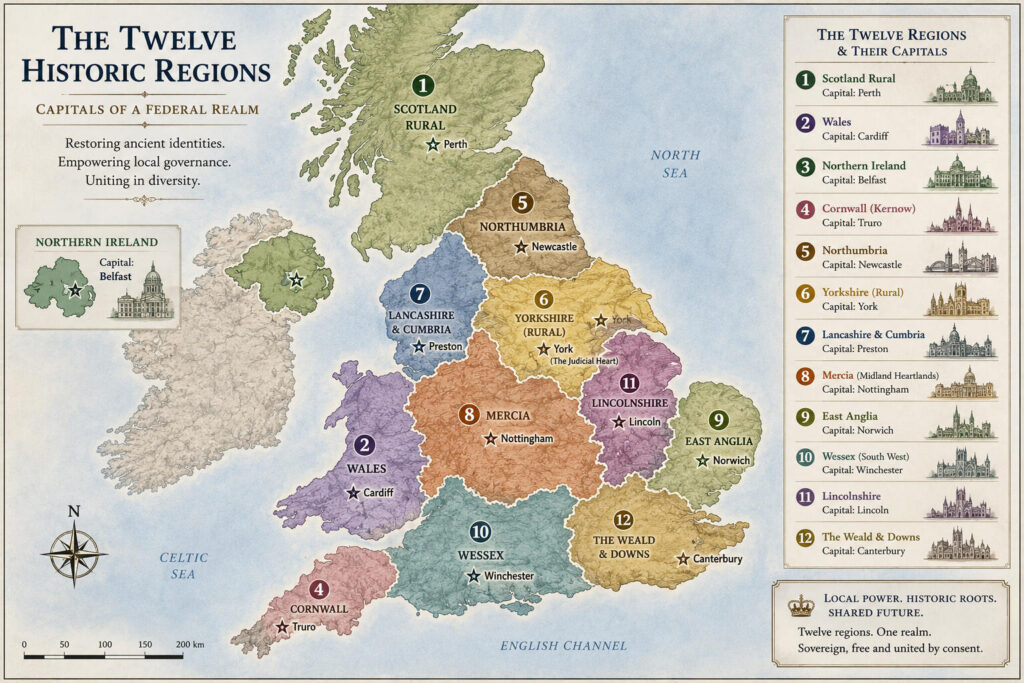
The remainder of the realm is restored to its natural, historic regional boundaries. We reject the sterile, compass-point regions drawn by Whitehall cartographers and return to historic boundaries and identity rooted in soil and culture. We start with the Celtic nations recognising their existing rights to self-determinations and expand their status, using them as the model to found our federal nation:
1. Scotland (Rural & Highlands)
Territory: Encompassing the Highlands, Islands, Borders, and Aberdeenshire, freed from the dominance of the Central Belt.
Restored Capital: Perth. Gateway to the Highlands, avoiding southern metropolitan gravity.
Population: 1.4 – 3.1 million.
Encompassing the Highlands, Islands, Aberdeenshire, and the Southern Borders. Freed from the political dominance of the Central Belt, Perth stewards the immense natural resources of the north: forestry, deep-sea fisheries, marine renewable power, and fresh water.
2. Wales
Territory: The nation of Wales.
Restored Capital: Cardiff. A civic capital grounded in both urban industry and mountain hinterlands.
Population: 3.2 million.
A unified, bilingual Celtic nation. Anchored in its historic southern port, Cardiff coordinates the industrial valleys, rural agriculture, and rich cultural heritage of the Welsh nation.
3. Northern Ireland
Territory: The six historic counties of Ulster.
Restored Capital: Belfast. The historic capital and seat of power in Northern Ireland.
Population: 1.9 million.
Governed directly from the Lagan. Belfast provides a practical civic assembly where local governance, trade, and community reconciliation are managed directly by those who live with their history.
We add one more that has historically been denied its heritage due to small size and subjugation. We refuse to dilute its distinct identity by forcing it to merge with another and instead protect its culture by ensuring they answer to themselves alone:
4. Cornwall (Kernow)
Territory: The distinct Celtic peninsula of Cornwall.
Restored Capital: Truro. While small Truro has long been Cornwall’s administrative centre, tending to be overlooked and orchestrated as a puppet state from regions to the East. No more will they be expected to kneel before a false authority.
Population: 0.6 million.
Critics will immediately point out that Cornwall’s population is smaller than typical regional groupings. Cornwall is conventionally smaller in demographic weight, however, its distinct Celtic national identity, language, geography, and maritime culture demand constitutional protection. It is explicitly separated from the English South West to prevent its unique heritage from being swallowed by a broader administrative boundary.
Now we must tackle England, despite what we are told it has never been one people or culture, even its language while shared varies greatly from shore to shore. When people ask what is great about England, it is often hard to answer, even our flag belongs to a Roman soldier who likely never visited our island, but the answer is found in our differences. England is not one culture but a natural melting pot of many, our greatest successes are in our ability to adapt and absorb other cultures into our own. It is often stated that the English will never agree on anything, this is because our nation while small is too vast and varied, it is simply because we are not one people, but many, and it is in numbers we find our greatest strength. We need to stop protecting our false union, and instead recognise and defend our differences, so we can truly come together as never before, and for that we need to recognise that our nation is still heavily divided into the ancient Saxon kingdoms, with that in mind, we need to build a New Heptarchy.
5. Northumbria (The Bernician Borderlands)
Territory: Northeast England, north of the Tees, including Northumberland, Durham, and the Tyne and Wear valleys.
Restored Capital: Newcastle. The historic shield of the northern realm, where industrial, coastal, and rural communities meet.
Population: 2.1 – 2.8 million.
Restoring the historic northern border marches from the Tweed to the Tees, combining industrial maritime grit with deep rural valleys. Newcastle serves as the natural cultural and economic anchor for a region combining deep-sea maritime traditions, green energy, and rugged upland agriculture.
6. Yorkshire (Rural & Agricultural)
Territory: The vast agricultural Ridings of North, East and West, excluding the dense West Yorkshire urban sprawl of the Leeds-Bradford-Sheffield conurbation.
Restored Capital: York. Seat of the historic Council of the North.
Population: 1.7 – 1.8 million.
The proud historic ridings of the North, freed from the West Yorkshire urban conurbation. Governed from the ancient seat of York, it focuses on agricultural engineering, manufacturing, coastal fisheries, and regional trade.
7. Lancashire & Cumbria
Territory: The county of Cumbria and rural/semi-rural Lancashire, excluding Greater Manchester and Liverpool.
Restored Capital: Preston. A gritty railway junction sitting between the heavy industrial spine of the Red Rose county and quiet Cumbrian fells.
Population: 0.8 million.
Unifying the industrial red-rose spine of Lancashire with the fells and lakes of Cumbria. Preston serves as the central railway backbone and administrative junction, balancing Cumbrian natural water and energy assets with Lancashire’s industrial heritage.
8. Mercia (The Midland Heartlands)
Territory: Staffordshire, Derbyshire, Nottinghamshire, Shropshire, Worcestershire, and Warwickshire – excluding Birmingham.
Restored Capital: Nottingham. The heart of England, managing the industrial legacy and river valleys of the Midlands. Tamworth and Lichfield have a greater claim as the ancient seat of the Mercian Kings, but this is not a historical experiment. Nottingham is much larger, better connected and has greater historical significance, having only been rejected by the Mercian Kings when it fell to the Danelaw.
Population: 4.5 million.
The ancient heartland of England, governing the industrial valleys, agricultural plains, and manufacturing legacy of the Midlands, freed from the shadow of Birmingham Metro.
9. East Anglia
Territory: Norfolk, Suffolk, Cambridgeshire, extending west into the scientific corridors of Oxfordshire.
Restored Capital: Norwich. A proud, independent civic power, neutral to Oxford and Cambridge rivalries.
Population: 3.2 million.
The proud, non-conformist eastern province, with the educational and technological powerhouse that is Oxbridge. Governed from Norwich, deep into Iceni heartlands, focusing on fenland agriculture, maritime ports, and North Sea energy networks.
10. Wessex (The South West)
Territory: Somerset, Wiltshire, Dorset, Gloucestershire, and Devon.
Restored Capital: Winchester. Gateway to the Southwest in a dominating position between Southern Coast sprawl. Capital of Alfred the Great and cradle of English administrative history.
Population: 3 million.
The historic southern kingdom, stretching from the Hampshire basin across the West Country plains. Governed from Winchester, stewarding defense technology, naval ports, and ancient agrarian landscapes.
Now we must address another distinct culture, Lincolnshire. The ancient Saxon Kingdom of Lindsey didn’t remotely resemble the Lincolnshire of today, and that is likely why it was considered a lesser kingdom and was soon absorbed into Mercia. However while size is still it’s enemy, I don’t think anyone who has spent time there would disagree that it has a culture all of it’s own. Much as Cornwall does, it is different to other regions and that makes the people there think differently. It is because of this that it is important to recognise their sovereign right to self-determination, to ensure that this culture will not be erased or weakened by making it play second fiddle to another.
11. Lincolnshire
Territory: Lindsey, Kesteven, and Holland—stretching from the Humber down to the Wash.
Restored Capital: Lincoln. Crowned by its cliff top cathedral, overlooking agricultural plains.
Population: 0.8 million.
Like Cornwall, Lincolnshire’s inclusion as a distinct sovereign region is the exception that proves the rule. As the undisputed agrarian heartland of the island, merging Lincolnshire into a broader East Midlands or Yorkshire entity would dilute its agricultural identity and lead to its absorption by larger urban neighbors. Sovereign status protects its vital silt, soil, drainage, and food security that keeps the rest of the country fed.
Finally we must consider what to do with the remaining land, all other regions have expressed some interest in self-determination, but the South East between London and the Channel seem content to leave things as they are. This makes sense as it tends to be somewhat of a suburban commuter zone for the metropolis. Of course what normality can be had when most of the country has already been removed? In Belgium when the idea of devolution took off, it was only a small handful of regions that requested it, however thinking it was such a great idea, the government then enacted a policy of “Devolution for everyone”. The result of this policy was those regions that did not ask for it typically ended up worse off as a result, the issue was never that the country was too centralized, it was that the people weren’t being listened to as a result of that centralization. The moral of this story is not to lose sight of your goal, and that’s why this entire proposal must be taken through formal approval processes with the people it would affect, until such a time it is nothing more than a speculative idea to show what can be done. What this means for the Southeast is that we should not try to split it any further, the House of Commons as we know it becomes theirs alone, and all that is left to do is make it an English Parliament, equivalent to the one each other region has. So the result is that the Southeast effectively becomes its own region by virtue of the fact that they are all that remains.
12. The Weald & Downs (The Saxon Shore)
Territory: Kent, Sussex, Surrey, and Hampshire, excluding Greater London.
Restored Capital: Canterbury. Ancient spiritual capital and gateway to Europe.
Population: 5.2 million.
The South East outside London has historically lacked interest in artificial “regional” autonomy, sitting as the historic crucible where English identity was forged. Therefore, we reclaim the Southeast from London’s commuter shadow. Governed from Canterbury, the Weald & Downs forms the administrative seat of the reformed English Parliament (the evolved domestic successor to the Commons for English affairs). This region restores self-determination to the chalk ridges, ancient forests, fruit orchards, and maritime coastlines of Kent, Sussex, and Surrey. Beyond that, the English Parliament serves as the dedicated stewardship hub for The Channel Islands, the Isle of Man, and British Overseas Territories. These territories will no longer be treated as second-class colonial footnotes or tax-haven anomalies; they gain direct administrative care, structural representation, and institutional protection within the federation.
Part III: The Mechanics of Equilibrium: How the Federation Functions
A common objection raised by defenders of the centralized status quo is the fear of inter-regional conflict and fragmentation: If you break up the unitary state, what prevents these twelve regions and four metropolises from descending into warring nation-states fighting over water, power, and food?
The answer lies in constructing mutual economic dependencies backed by an unamendable constitutional lock. The federal model prevents fragmentation not by central force, but by making them interdependent in a way that enforces a natural symbiotic relationship, a city cannot live without food, and citizens of rural regions need access to services a market town simply cannot provide.
1. Bottom-Up Fiscal Sovereignty (The 50-30-20 Rule)
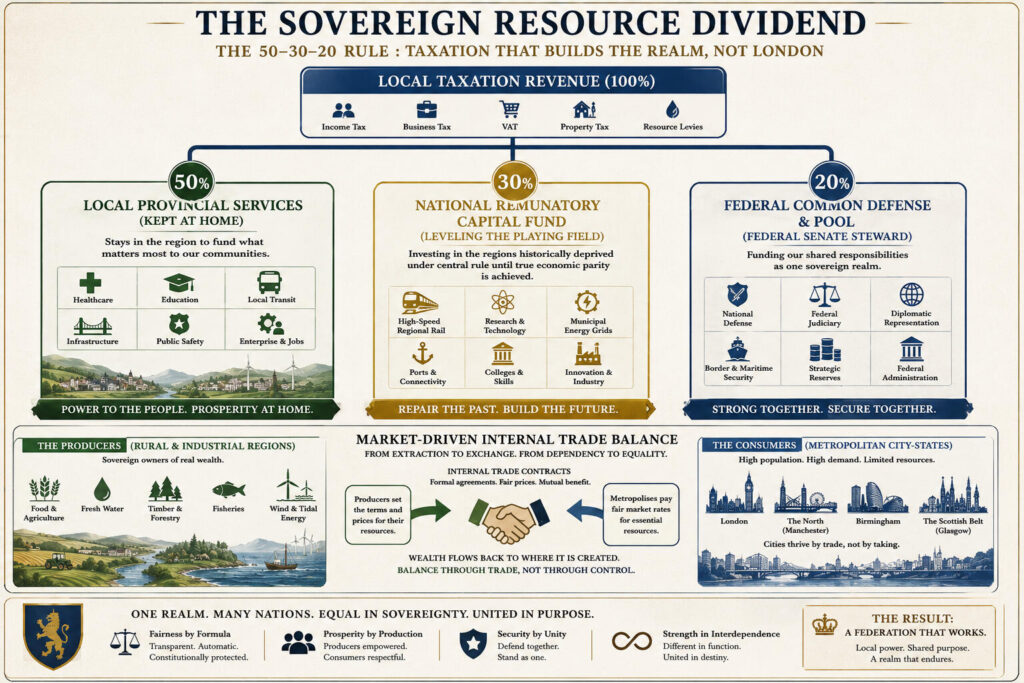
We banish the begging-bowl economy where Westminster collects national taxes and uses the Treasury to block grants acting as puppet strings to control local councils. Instead, we establish a Bottom-Up Fiscal Architecture modeled on robust federal systems:
- Direct Local Levying: Each tier of governance (Parish, Region, and Federal) levies and collects its own taxes directly at the source. Westminster never touches provincial funds, eliminating any central leverage to withhold funding or bully local authorities.
- The Distribution Rule: Of all revenues collected within a region, finance is governed by a transparent, automatic formula embedded in the federal constitution:
- 50% stays at home, remaining in the region to immediately fund local public services, infrastructure, and enterprise. Tax generated in Lancashire, Lincolnshire, or Wales remains there to directly fund local hospitals, schools, municipal transit, and regional infrastructure.
- 30% flows into the National Remunatory Capital Fund. This is a legally protected sovereign wealth fund dedicated exclusively to repairing the 1,000-year historical infrastructure deficit in the North, the West, and the Celtic nations under London rule. It pays for high-speed regional rail, technological research colleges, and municipal energy grids until structural economic parity across all twelve regions is reached. Crucially it rebuilds mundane infrastructure, and does not become some empty campaign to back political propaganda, instead thoroughly fixing the broken pieces of our nation without fanfare.
- 20% flows to the Federal Senate Treasury. This pool funds shared macro-necessities: national defense, federal judicial oversight, and baseline diplomatic representation abroad.
2. Market-Driven Internal Trade Balance
Under the current centralized system, London extracts resources from the provinces for free or at depressed cost, using its administrative dominance to manipulate energy and water pricing.
Under this new model, resource-producing rural regions (like Lincolnshire, Scotland Rural, and Wales) hold real economic leverage over consumer metropolises (like London and Manchester).
In our federal model, the power dynamic is flipped:
- Rural and industrial regions (such as Lincolnshire, Scotland Rural, Northumbria, and Wales) hold sovereign ownership over their physical assets: fresh water, agricultural yield, timber, coastal fisheries, and wind/tidal power.
- The four consumer metropolises (London, Manchester, Birmingham, and the Scottish Belt) possess massive populations but virtually no natural food or energy production.
- If Greater London or Birmingham Metro requires freshwater from Wales, food from Lincolnshire, or green electricity from Northumbrian wind farms, they cannot extract it by central decree. They must enter into formal Internal Trade Contracts, paying a fair market-rate resource levy directly to the producing region’s treasury.
Wealth automatically and continuously flows out of the consuming cities and back into the producing countryside, achieving economic equilibrium through natural market balance rather than federal charity handouts.
3. The Touring Senate
To ensure the Federal Senate never becomes an isolated political bubble, or develops a claustrophobic political culture like SW1, the Senate is mandated to be a touring body.
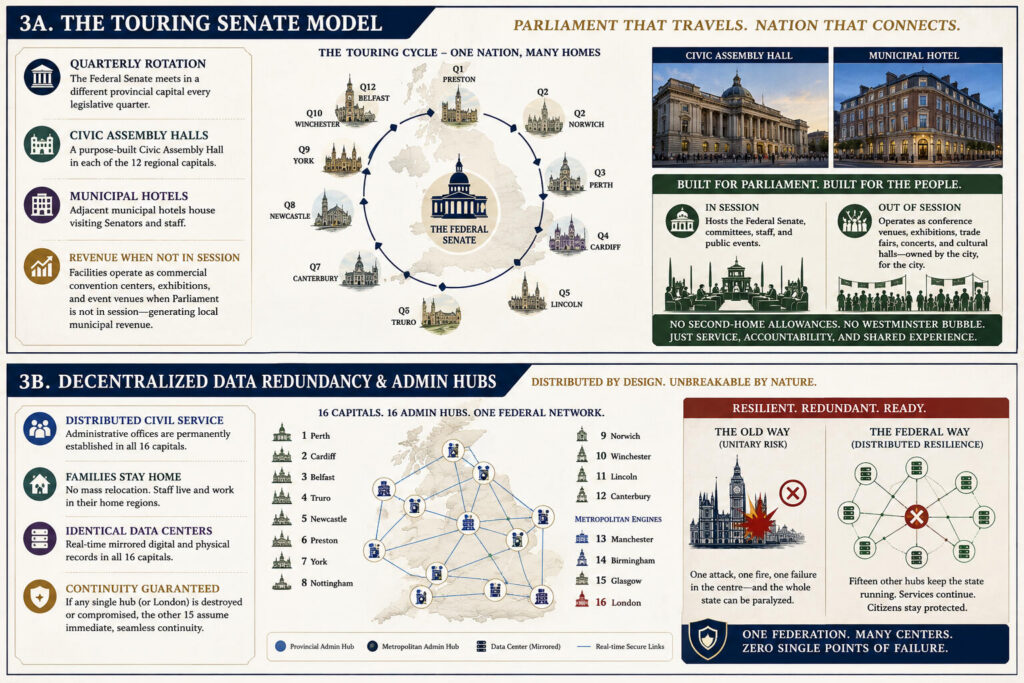
- Quarterly Rotation: The Federal Senate sits in a different provincial capital every legislative quarter—rotating continuously through all 16 capitals.
- Dual-Use Civic Infrastructure: In each of the sixteen provincial capitals, a multi-purpose Civic Assembly Hall is constructed, alongside an adjacent municipal hotel. When the Senate is in town, these facilities host the legislature and its administrative staff, completely eliminating the corrupt system of second-home allowances and parliamentary expense claims.
- Municipal Revenue Generation: When the Senate is not sitting in that specific region, the municipal hotel and assembly hall operate as commercial conference venues, trade exhibition centers, and cultural halls, owned entirely by the local city council. They generate steady commercial income for the local community rather than draining public funds.
By forcing federal politicians to live, work, and travel continuously across the entire geography of the realm, they gain immediate personal experience of the practical realities of every region. This is how we break the claustrophobic arrogance of SW1 and bind the nation together through shared civic experience. The arrogant, out-of-touch bubble of Westminster rule dies a natural death.
Civil Service Stability and Redundant State Records
While senators tour, we do not force civil servants to live out of suitcases away from their families. Administrative support functions are divided permanently into small, fixed regional offices across all sixteen capitals.
Crucially, this creates Total Federal Data Redundancy:
- Identical, mirrored digital and physical record stores are maintained continuously across all sixteen provincial capitals.
- Under the old unitary state, a fire, cyber-attack, or catastrophe in Whitehall could paralyze the entire national administration. Under this federal network, if a central record office in London or Manchester is destroyed, fifteen other capital hubs possess real-time, identical copies of all federal data and can step up instantly to handle the load. The state becomes decentralized, resilient, and un-shockable.
- A concensus network between the offices ensuring legislature is not documented by one individuals interpretation of something a politician said. It must undergo a rigorous majority approval process that the legislation is in fact an accurate representation of the request authorized and continuity tested by a number of experienced civil servants in various environments before being added to legislation.
- In the event of a disaster the other offices don’t need to get up to speed on the work as they are already actively working as part of it. This completely eradicates lead times during disaster recovery.
Conclusion: Building the Tomorrow We Deserve
The state we inhabit today is exhausting itself. It is a creaking, over-centralized machine held together by public cynicism, failing infrastructure, and political theatre.
We do not have to accept this slow decay as our destiny. The federal model presented here is not an exotic blueprint imported from afar and it is not a utopian dream; it is a practical, hard-headed architectural plan to replace a collapsing unitary state with a durable, high-trust federation. It is the organic restoration of who we have always been – a diverse, proud union of distinct regions, bound together by mutual respect, shared resource equity, and rigorous local democracy.
We have drawn the map. We have established the 12 historic regions and 4 isolated metropolises. We have designed an unhackable electoral system using Schulze STV and constrained MMP that brings political parties to heel while honoring their role in statecraft, pushed democratic power down to the parish bedrock. We have established bottom-up taxation,distributed the levers of state power across the geography of the realm, and forged an automatic economic balance that prevents regional conflict.
The architects of the old order will tell you that this vision is too radical, too expensive, or too complex. They say this because centralization is the source of their privilege. We say that the true radicalism is continuing to tolerate a system that leaves millions of citizens voiceless, broke, and ignored in their own home towns.
It is time to put an end to the deception. It is time to dismantle Westminster, empower our regions, and build a decent, high-trust, federal Britain on the soil where we stand.
The constitutional frame is built. But a vital, dangerous task remains.
Beyond the visible halls of Parliament lies the invisible, permanent engine of British central power: the permanent administrative class of Whitehall. The civil service mandarins, the Treasury clerks, and the entrenched executive bureaucracies will not quietly surrender their central monopoly simply because a new constitution is written. They will leak, stall, invent administrative crises, and attempt to sabotage the new federation from within.
In our next piece, we will pick up the scalpel and address the heart of the central machine: how to systematically dismantle, disperse, and rebuild Whitehall itself.