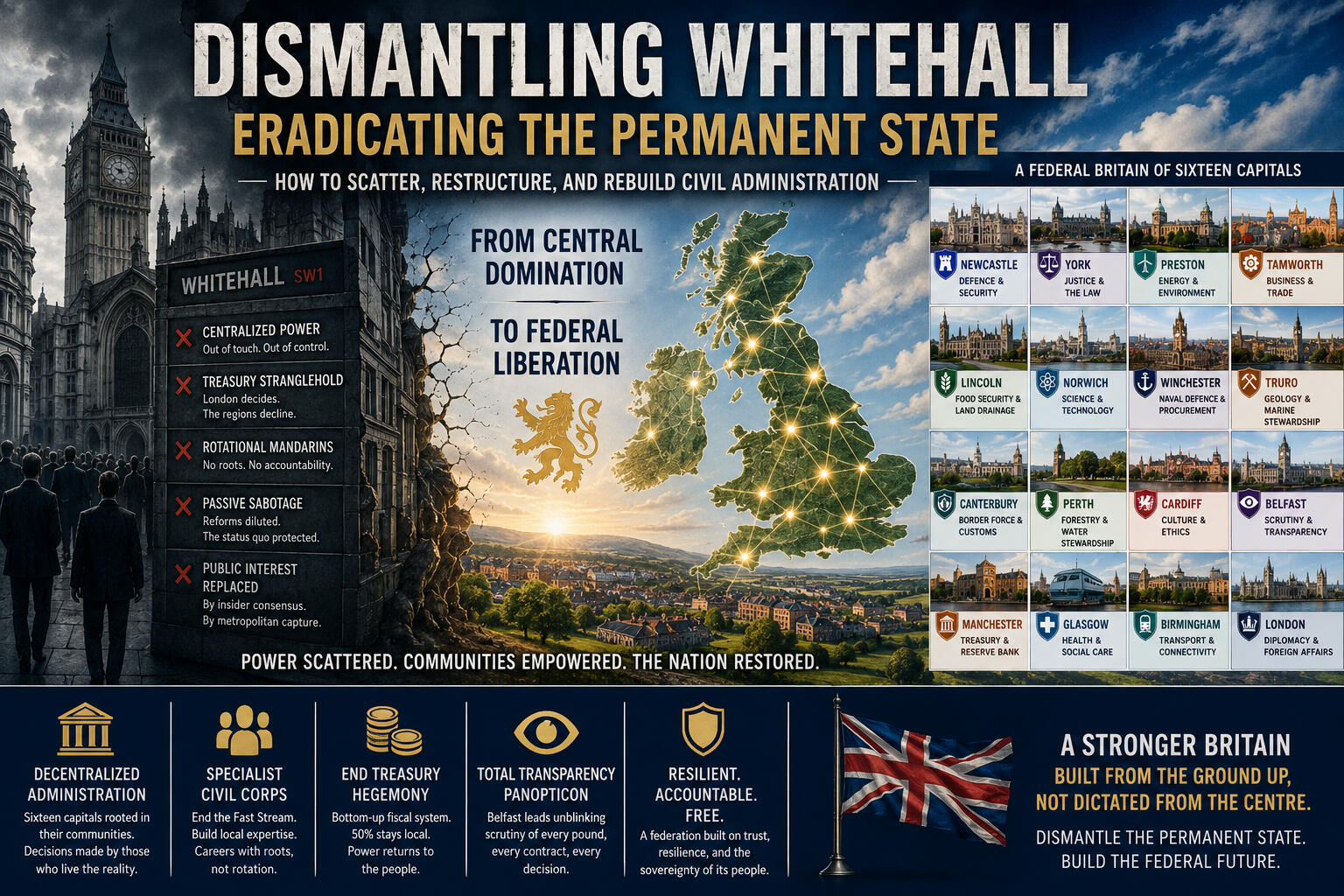
Whitehall is not simply a collection of government offices; it is a highly centralised administrative system with its own incentives, institutional memory, and concentration of power. This article argues that a federal Britain cannot survive while that machinery remains intact, and proposes replacing the unitary civil service with a geographically dispersed network of regional and metropolitan administrations. Departments are rooted where their work actually happens, the Treasury is relocated away from London, specialist expertise replaces perpetual bureaucratic rotation, and an independent scrutiny system makes government radically more transparent. The result is intended to be a state that is less concentrated, more locally knowledgeable, more resilient to failure, and ultimately more accountable to the people it serves.

What would Britain look like if we stopped trying to reform Westminster and redesigned the state from the ground up? A federal UK of twelve historic regions and four autonomous metropolises, with power, taxation, representation and administration distributed across the country rather than concentrated in London.
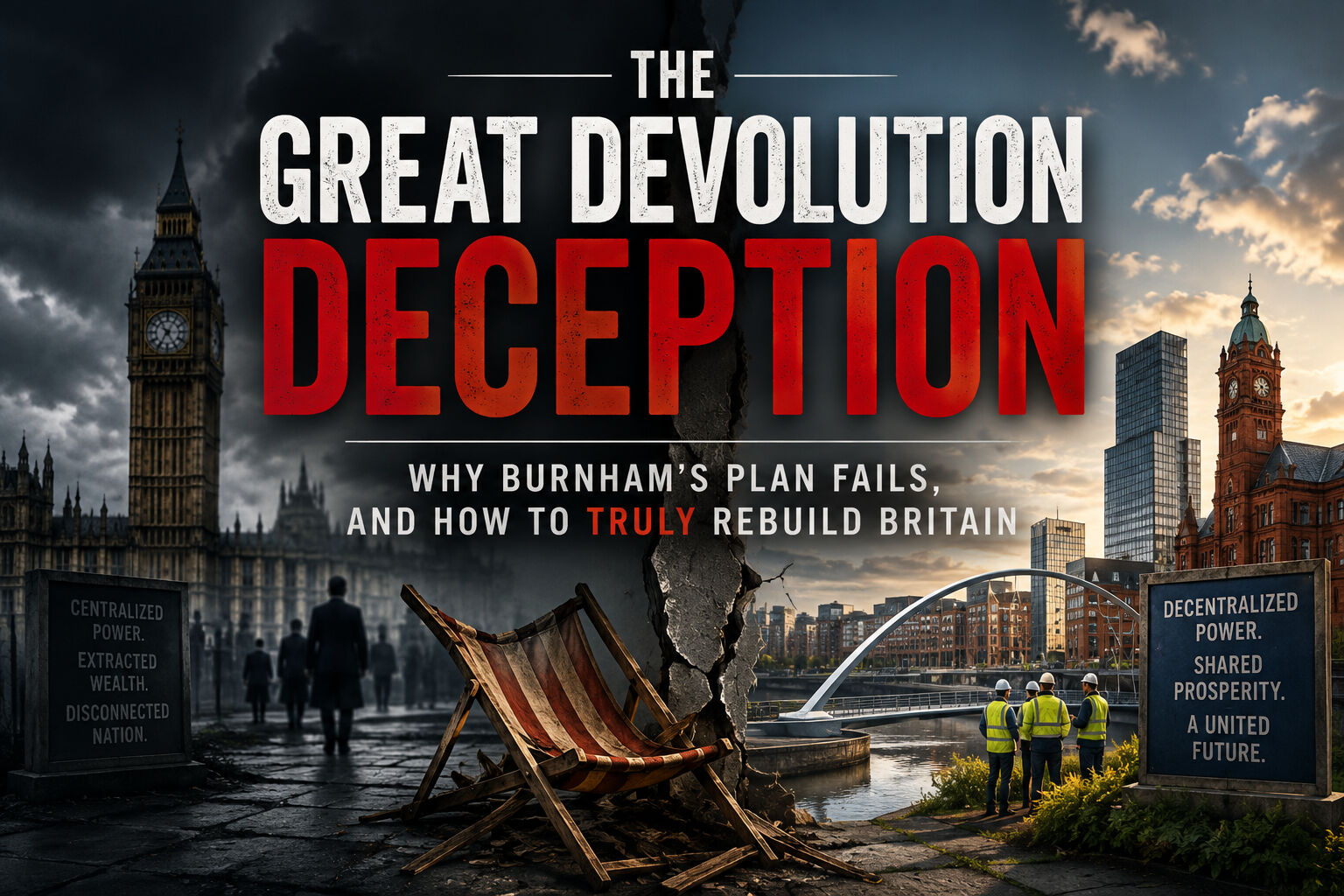
We are told the British state is reforming itself, but current devolution proposals merely relocate centralised power rather than dismantling it. We don’t need “devolution by permission” from Westminster; we need a radical, high-trust constitutional rewrite.
The UK governance model is afflicted by a toxic, chronic condition: hyper-centralisation. This is not merely an accident of history but the deliberate, sustained effort of an overarching political class convinced of its own superior knowledge.
Some counties, like Yorkshire, possess the identity, culture, and critical mass to stand as a region in its own right, with a distinct economic engine and a population larger than Scotland. Other counties would be at liberty to form clusters, with the consent of their populations, to create new county regions with a shared identity and governance.