Danelaw, Geopolitics, and the Global Future of a Federal UK
In Constructing the Federal UK and Dismantling Whitehall, we set out the constitutional skeleton and administrative mechanics of a high-trust, decentralized republic. We mapped the Twelve Sovereign Regions and Four Isolated Metropolises, established bottom-up fiscal mechanics (50/30/20), and dispersed the permanent state across sixteen capitals to eliminate the SW1 monopoly forever.
Yet, a constitutional blueprint remains fundamentally incomplete if it treats a country merely as a blank sheet of paper or an administrative grid. A federal state cannot survive if it ignores the deeper, organic fault lines carved into its soil over millennia.
Westminster’s cardinal error – and the ultimate cause of its modern paralysis – has been its stubborn, imperial insistence that England is a single, homogeneous nation that can be governed by a single London-centric doctrine. In truth, England has always been two distinct nations wearing a single coat. Below the noisy surface of contemporary political spats over rail lines, transport funding, and regional investment lies a thousand-year-old division – one that stretches back to the ancient, unforgotten border of the Danelaw.
To build a federal state that endures for centuries, we must stop attempting to force the North and the South into an artificial, suffocating cultural unity. We must embrace their distinct historical identities, honor their differing legal and social origins, allow them to pursue their natural geopolitical alliances, and leverage our newfound federal transparency to position a reformed United Kingdom as the premier global broker of international commerce, legal arbitration, and trust.
Part I: The Danelaw Legacy: Why the North and South Are Two Separate Peoples
The “North-South Divide” is not a temporary byproduct of post-industrial decline, nor is it a modern statistical anomaly manufactured by think-tank reports on regional GVA disparities. It is a structural, civilizational reality carved into the geography and genetics of Britain over a thousand years ago, and reinforced by a economic focus on the centre, hanging the regions out to dry.
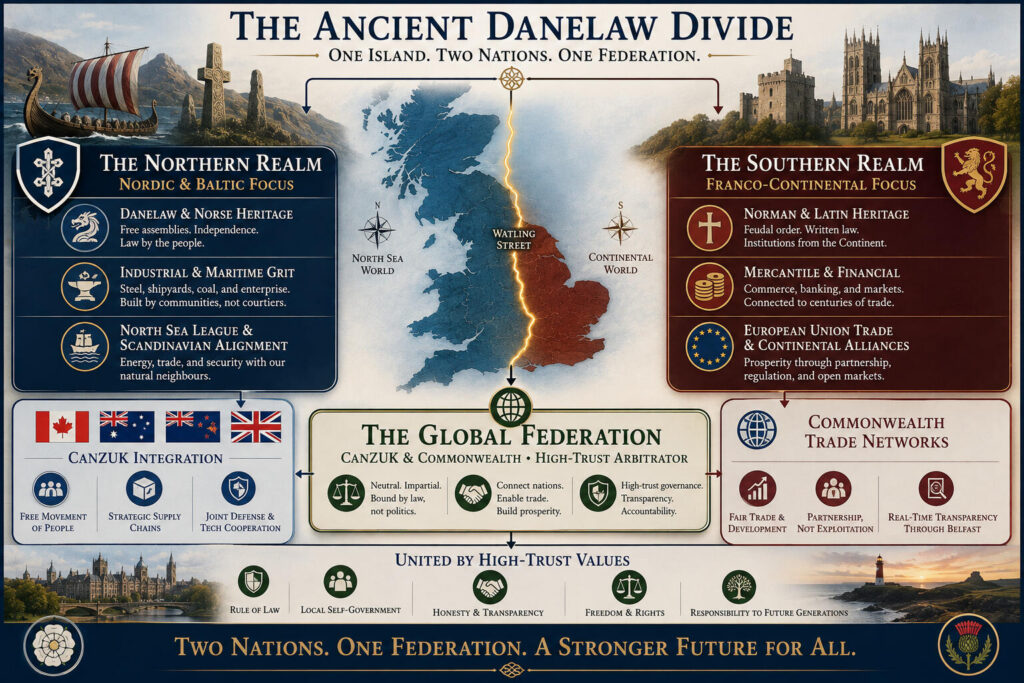
When King Alfred of Wessex and the Viking warlord Guthrum negotiated the Treaty of Wedmore (878 AD) following the Battle of Edington, they sought a lasting peace between their people. So in the later Treaty of Alfred and Guthrum (circa 886) they drew an explicit border running northwest along the ancient Roman road of Watling Street – stretching from London, up along the River Lea and Ouse, through the heart of the Midlands to Chester. To the south and west lay Anglo-Saxon Wessex and its client territories; to the north and east lay the Danelaw (Dena lagu).
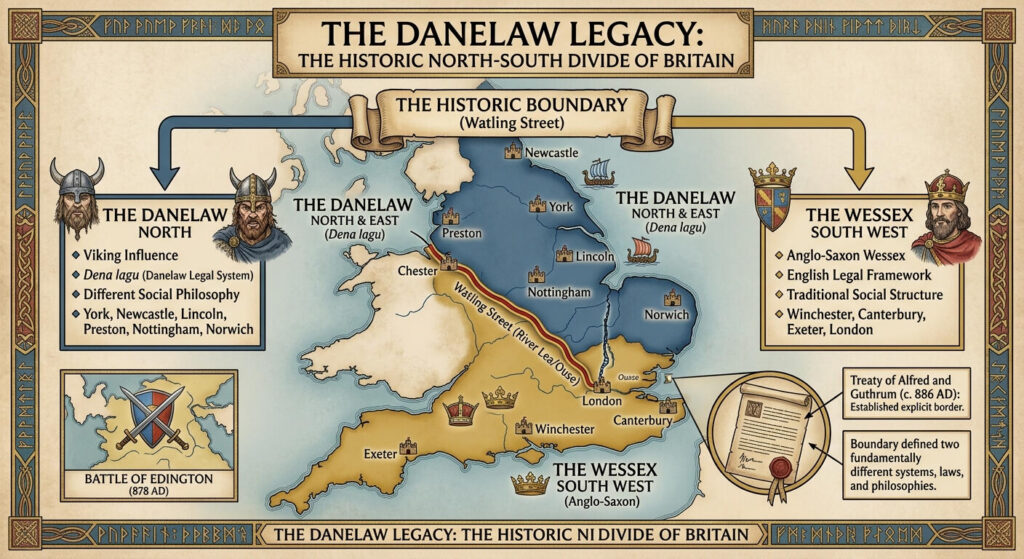
This treaty was not merely a military truce; it marked the boundary between two fundamentally different political systems, legal frameworks, and social philosophies that continue to define the psychological landscape of the island today.
- The Northern Character (The Danelaw & The Marches): Shaped by Scandinavian settlement, egalitarian village assemblies (the Thing), free peasantry (socmen), and intense local pride. From the ancient kingdom of Bernicia down through the Ridings of Yorkshire and the silt of Lincolnshire, the North developed a culture rooted in directness, communal solidarity, industrial grit, and a deep-seated suspicion of distant, southern authority.
- The Southern Character (Wessex & The Saxon Shore): Shaped by a more centralized feudal hierarchy, Norman administrative centralization, and proximity to continental Europe. The South developed an economy centered on land tenure, mercantile finance, courtly law, and diplomatic interface with Western Europe.
1. The Legal and Civic Contrast
The legal architecture of the Danelaw differed radically from the royal centralism of Wessex:
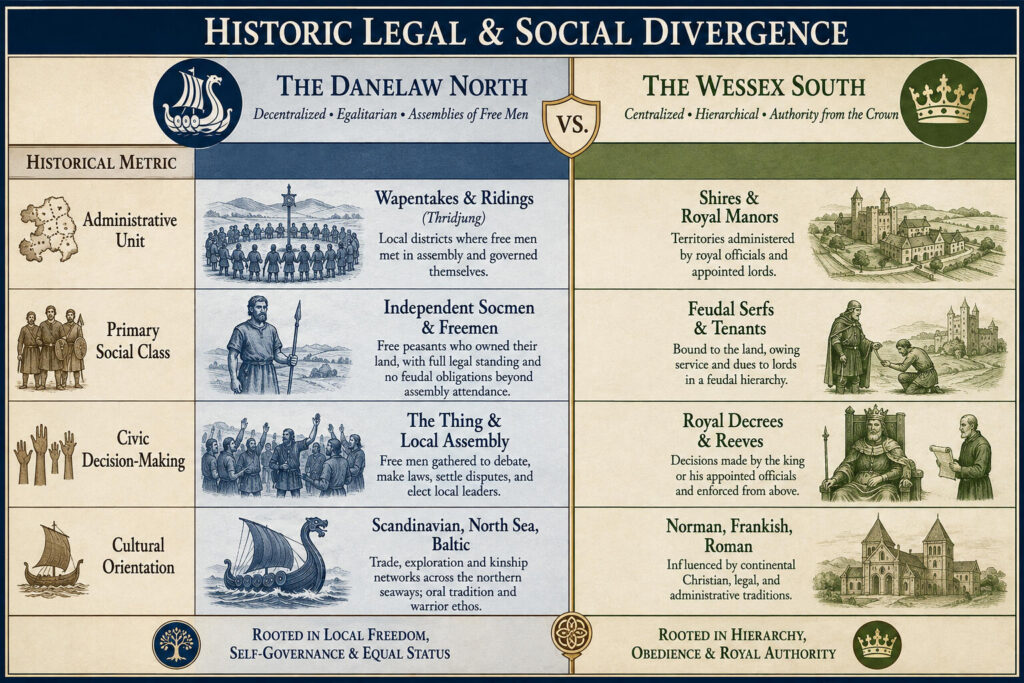
- Egalitarian Local Assemblies: While Wessex operated under a top-down, royal-charter hierarchy centered on the King’s reeves and feudal land grants, the Danelaw governed itself through decentralized local assemblies known as Things or Motes. The region was divided not into administrative shires, but into Wapentakes (“weapon-touching”), where free men gathered to ratify laws, settle property disputes, and confirm local leaders by clashing their weapons together.
- The Socmen and Free Peasantry: Long before the Norman Conquest, the Danelaw possessed an unusually high proportion of socmen – free peasants who owned their land outright, held personal legal standing, and owed no feudal service to a lord beyond local assembly attendance. This established a fierce tradition of individual independence and communal self-reliance.
- The Jury of Twelve: The very concept of an independent jury of twelve equal peers, sworn to investigate crime without royal decree, can be found in the Danelaw’s Ethelred Code of Wantage (997 AD), centuries before Norman jurisprudence attempted to claim credit for English common law. While it is unclear where the English legal system came from, what is obvious is that the North has a long history of collective legal judgement and justice as an individual right.
2. The Cultural and Psychological Rift
When William the Conqueror subjugated England in 1066, Wessex submitted with relative speed. The Danelaw North, however, rose in fiercest rebellion to defend its ancient liberties. William’s response – the brutal Harrying of the North (1069–1070) – was an act of systematic genocide designed to break the independent spirit of the Danelaw. Salt was sown into the fields, livestock slaughtered, and entire valleys depopulated.
Though the land was scorched, the culture survived underground. It persisted in the distinct dialects of Yorkshire, Northumbria, and Lincolnshire; in the cooperative traditions of Northern industrial guilds, miners’ welfares, and friendly societies; and in an enduring, visceral distrust of the Norman-derived ruling elite in Westminster.
The Southern character, conversely, developed along the lines of Norman administrative centralism, courtly finance, and continental mercantile trade. It accepted top-down governance as the price of order, viewing London as the natural sun around which all provincial planets must orbit.
Westminster’s fundamental error has been treating the North as if it were simply a poorer, more distant version of the South that merely needs to be “levelled up” through conditional handouts from London. By recognizing the North and South as two distinct cultural and historical realms within a single high-trust federation, we stop fighting a thousand-year cultural war and begin governing according to the true nature of the realm.
Part II: Geopolitical Realignment: The North Sea League vs. The European Union
Because the North and the South possess fundamentally different historical, cultural and economic orientations, forcing the entire island into a uniform, rigid foreign policy has crippled British diplomacy for over half a century.
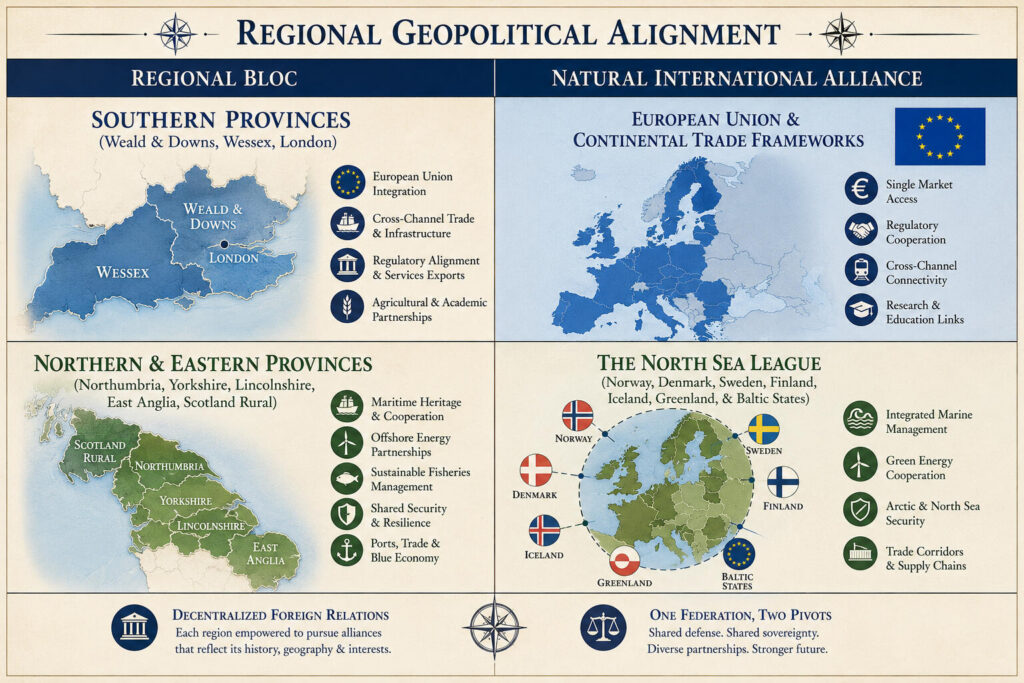
Every major geopolitical rift in modern British history – from the EEC entry in 1973 to the Brexit referendum in 2016 and subsequent trade disputes – has been a proxy war between these two regional instincts. The South, with its mercantile ties to Normandy, Flanders, and Latin Europe through London and its continental ports, seeks seamless integration with Western Europe, financial alignment with European markets, and the regulatory frameworks of the European Union. The North and East, with their deep maritime roots, offshore industries, and fishing heritage, feel alienated by bureaucratic directives originating from Brussels or Strasbourg and has historically looked across the North Sea toward Scandinavia, Denmark, Norway, Iceland, and the Baltic States.
Under our federal constitution, foreign relations are decentralized. While federal macro-defense and diplomatic recognition remain anchored in the Upper House of Regions, individual regional blocs are granted statutory authority to execute Bilateral Regional Treaties that serve their distinct economic and cultural priorities.
1. The Southern Pivot: European Union Integration
The Southern provinces – The Weald & Downs, Wessex, and the Greater London Metropolis – possess an economy heavily dependent on international finance, cross-Channel freight, professional service exports, and agricultural links with France and Flanders.
Under federal autonomy:
- London, Canterbury, and Winchester are empowered to utilize their federal autonomy to negotiate deep, frictionless trade agreements, legal arrangements, cultural exchanges and regulatory alignment with the European Union for financial services, agricultural trade, and academic exchange.
- Cross-Channel transit infrastructure, port logistics at Dover and Southampton, and customs harmonization are managed directly by Canterbury’s Department of Customs & Immigration in tandem with European partners, removing Westminster’s ideological posturing from practical trade.
2. The Northern Pivot: The North Sea League
Concurrently, the Northern and Eastern provinces – Northumbria, Yorkshire, Lincolnshire, East Anglia, and Scotland Rural are empowered to turn their eyes back toward their ancestral waters to forge The North Sea League.
This is not a theoretical diplomatic exercise; it is an economic and ecological alliance built on shared geography, physical assets and common values:
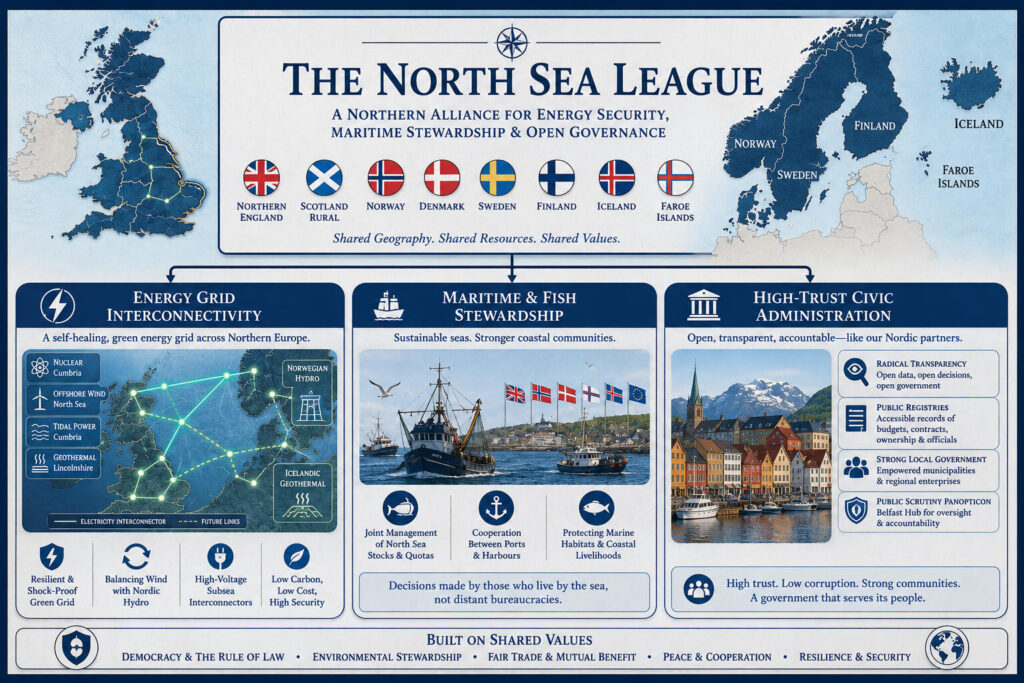
- North Sea Grid Interconnectivity & Strategic Security: The North Sea is rapidly evolving into Northern Europe’s primary energy engine. By linking the UK National Grid’s growing offshore wind and nuclear capacity to Norway’s flexible hydroelectric reservoirs via high-voltage subsea interconnectors, the region creates a mutually beneficial energy loop – using Nordic hydro to balance variable British wind. The proposal for an IceLink to bring in Icelandic geothermal power would bolster the grid with further stability and resilience. However, this dense web of subsea cables, gas pipelines, and offshore generation creates an immensely sensitive Critical National Infrastructure footprint. Surrounding nations must align not only on energy trading, but on joint maritime defense and intelligence sharing to protect these vital underwater lifelines from hybrid threats and external sabotage.
- Maritime and Fisheries Stewardship: The current centralist approach to fishing rights has devastated coastal towns from Grimsby and Whitby to Peterhead. The North Sea League establishes a joint, regional management council between Northern ports, Denmark, Norway, and the Faroe Islands, restoring sustainable catch quotas and protecting deep-sea marine habitats without interference from Mediterranean agricultural interests.
- High-Trust Governance Alignment: The Northern provinces adopt the Scandinavian model of civic administration – defined by radical salary transparency, open government registries, and strong municipal enterprise – supported directly by the Public Scrutiny Panopticon in Belfast.
Instead of fighting a bitter, perpetual civil war over whether Britain is “European” or “Isolated,” our federal structure permits both halves of the island to embrace their natural heritage. The South remains linked to Latin Europe; the North reclaims its place in the Nordic world and the Federal Senate manages inter-regional conflict and collaboration.
Part III: The Global Broker: CANZUK, the Commonwealth, and High-Trust Commerce
While individual regional blocs build their specialized European and Nordic alliances, the Federal Republic assumes its unified role on the international stage.
The centralized state reduced Britain to a tragic international figure: a faded imperial power clinging to past glory while begging for trade scraps from economic superpowers. A decentralized, high-trust Federal UK discards this imperial nostalgia and assumes a vastly more powerful position: not as a faded imperial power or a submissive rule-taker, but as The World’s Premier High-Trust Broker.
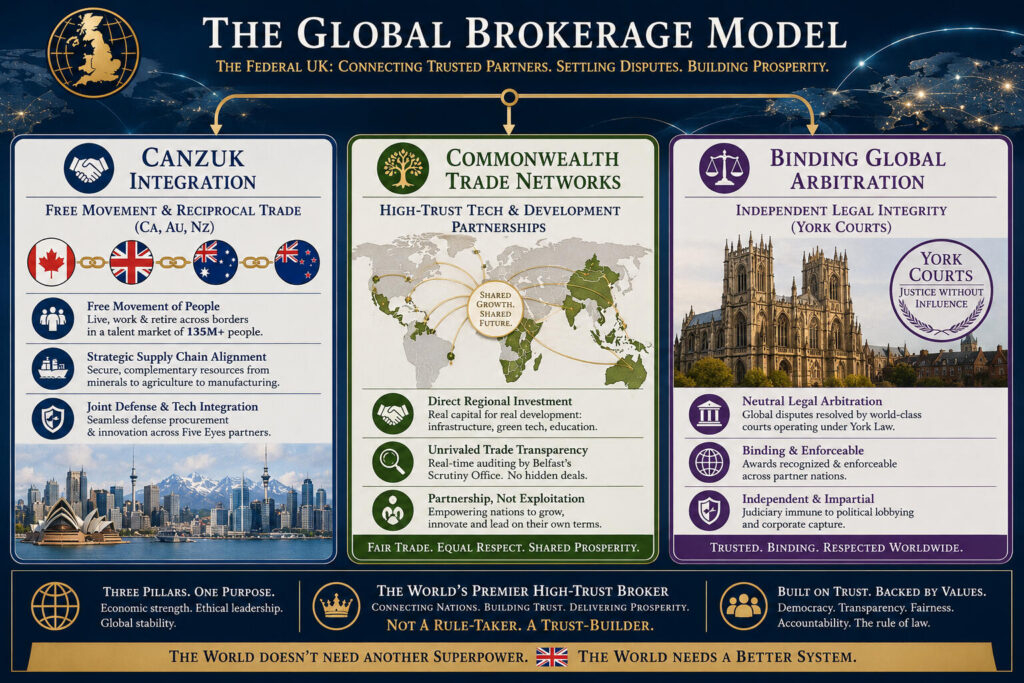
The United Kingdom possesses a diplomatic and legal asset that no continental European nation commands: centuries of shared common law traditions, language ties, and deep institutional relationships spanning 56 nations across the globe.
1. CANZUK: The Federal Anchor
The foundational pillar of our international architecture is the immediate, full enactment of CANZUK – a sovereign partnership between Canada, Australia, New Zealand, and the United Kingdom:
- Reciprocal Free Movement of Labor: Citizens of all four nations gain the right to live, work, and retire across borders without complex visa bureaucracies, creating an integrated talent market of over 135 million people.
- Strategic Supply Chain Alignment: Combining Canadian and Cornish mineral geology, Australian raw materials, New Zealand agricultural expertise, and Mercian manufacturing into a secure, non-coercive industrial supply chain.
- Joint Defense and Technological Integration: Linking Winchester’s Ministry of Defence Procurement Command directly into Australian and Canadian defense networks, transforming the Five Eyes alliance into a seamless technological shield.
2. Commonwealth Re-engagement: From Exploitation to Partnership
Beyond CANZUK, the Federal Republic revitalizes its relationships across the wider Commonwealth to rebuild genuine, equal trade partnerships. For decades, Westminster treated Commonwealth nations with patronizing neglect while focusing exclusively on European trade deals. Stripped of London’s historical arrogance, the Federal Senate offers Commonwealth partners transparent, fair-value trade agreements backed by direct regional investment rather than exploitative financial speculation.
The Federal Senate replaces the legacy of exploitation with High-Trust Fair Trade Charters:
- Direct Regional Investment: Rather than routing capital through speculative London hedge funds, regional treasuries in Manchester, Preston, and Nottingham invest directly in Commonwealth infrastructure, green technology, and educational exchanges.
- Unrivaled Trade Transparency: Every trade agreement executed by the Federal Senate is audited in real-time by Belfast’s Scrutiny Office, guaranteeing that Commonwealth partners are never subjected to hidden tariffs, corporate exploitation, or backroom political arm-twisting.
Crucially it puts the emphasis on giving back to the nations that suffered under imperial oppression, helping them to grow and providing the tools to become international superpowers in their own right. That is, helping all of them, rather than simply kneeling before those that do well on their own and prioritizing a “special relationship” with the US that they casually cast aside when it comes to returning the favour.
3. The World’s High-Trust Arbitrator
By physically separating our state levers – placing the High Judiciary in York, the Treasury in Manchester, and the Audit Panopticon in Belfast – we establish a transparent un-bribable institutional framework that exists nowhere else on earth.
In an increasingly unstable world characterized by geopolitical friction, corporate fraud, and state surveillance, international corporations, foreign governments, and global trade bodies desperately require neutral, transparent territory to resolve legal disputes, hold asset escrows, and validate supply chain contracts.
Because our federal constitution criminalizes off-the-record political collusion under pain of high treason, the Federal UK becomes the undisputed global capital for international legal arbitration, high-trust finance, and ethical commerce.
- York becomes the undisputed global capital of legal arbitration. International commercial contracts will specify York law as their binding jurisdiction, knowing the judiciary is entirely immune from London political lobbying.
- Manchester becomes the trusted vault for international clearing. Global commodities and cross-border digital assets are registered in Manchester, backed by real manufacturing reserves rather than speculative real estate bubbles.
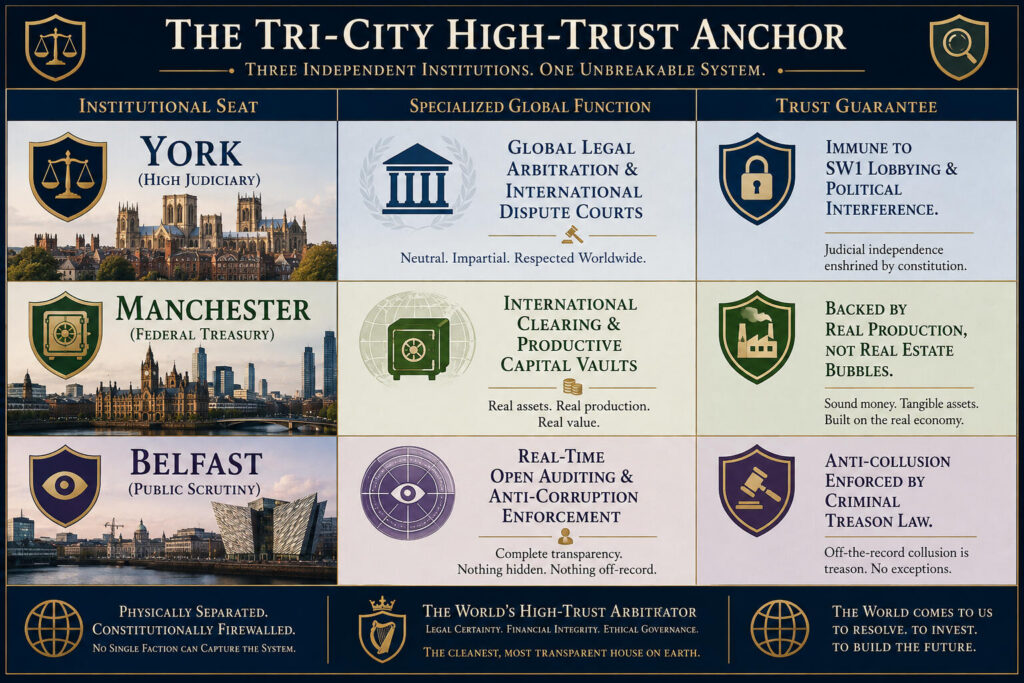
The Federal UK does not beg for a seat at foreign tables; it builds the cleanest, most transparent house on earth, compelling the world to come to us.
Part IV: Deepening the Cultural Foundations: Identity Beyond the State
A constitutional architecture without a cultural soul is merely administrative engineering. The success of the Federal UK relies on reclaiming identity from artificial state nationalism and returning it to the soil, the history, and the living traditions of our communities.
For over three centuries, the central state has attempted to forge a synthetic “Britishness” or a homogenous “Englishness” designed to serve the needs of empire and war. In doing so, it erased the authentic, localized identities that sustained our people for centuries.
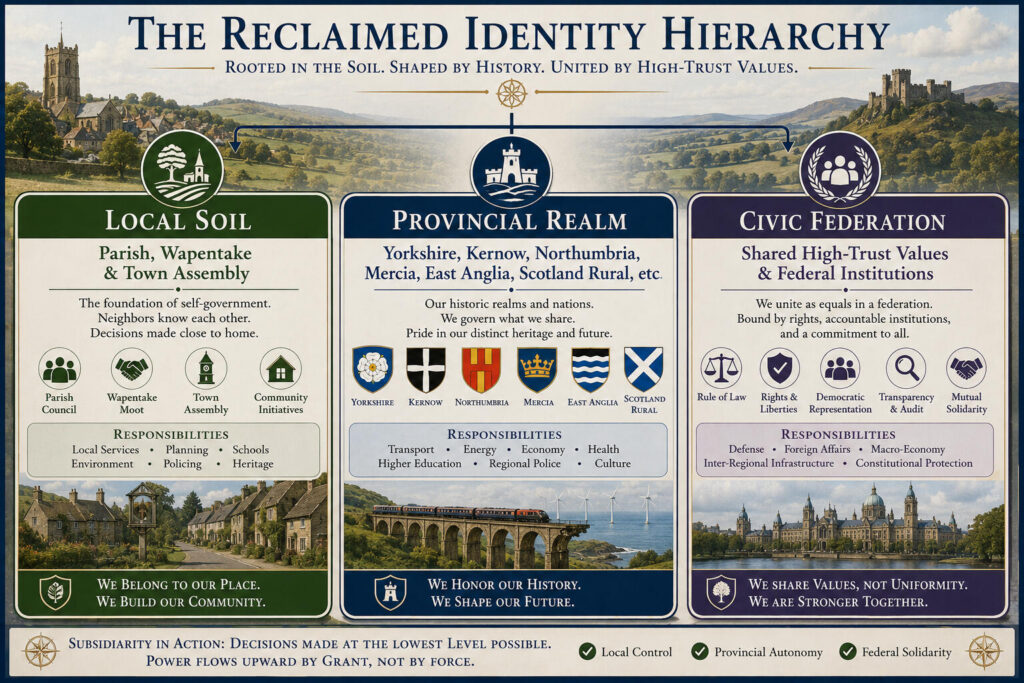
1. Moving Beyond Synthetic Flags
As analyzed in the Yorkshire Popular Front’s cultural critique, traditional national symbols like the St. George’s Cross have been increasingly co-opted by partisan factions and divisive political movements. When a national flag becomes a partisan weapon, it ceases to be a unifying symbol.
The Federal Republic solves this cultural crisis by shifting civic reverence away from national flags and toward regional, soil-rooted iconography:
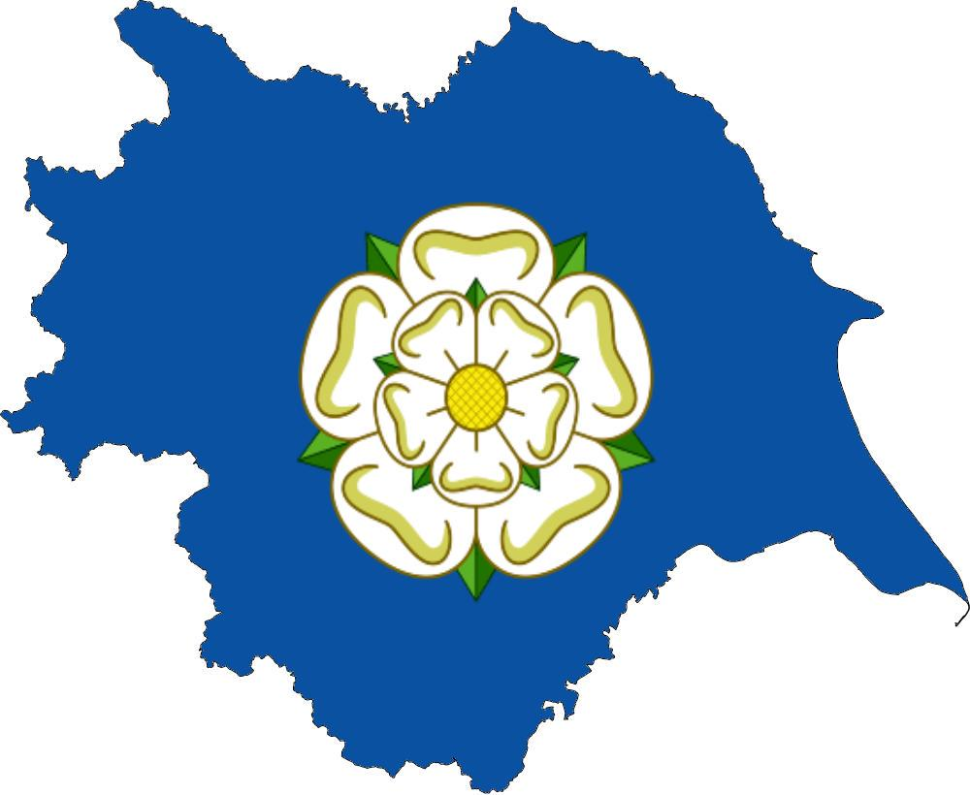
- The White Rose of Yorkshire, the Flag of St. Piran in Cornwall, the Cross of St. Cuthbert in Northumbria, and the Saxon Crown of Mercia carry no baggage of imperial conquest or far-right co-option. They represent an authentic, secular connection to land, local history, and shared community pride.
- A citizen of Truro, York, or Newcastle does not need to pledge allegiance to a central state flag; their civic duty is expressed through active participation in their local parish assembly, town council, and regional parliament.
2. The Return of Subsidiarity in Action
True regional identity is not about nostalgia or flat caps and folklore; it is about practical self-determination.
When a community controls its own transport networks (reopening lost lines like the Minsters Rail link between York and Beverley), builds its own municipal energy infrastructure (utilizing wind energy of the North Sea all along our coastlines), and sets its own local council tax rates, under a fair and representative electoral system where every vote counts, civic apathy vanishes.
Identity is transformed from a passive consumer label into an active democratic duty. People care about their region because their region finally belongs to them.
Conclusion: A Nation Restored to Its Soil and the World
The centralized unitary state reduced Britain to a exhausted, confused, and angry country – paralyzed by a permanent identity crisis, at war with its own regions, and endlessly debating its place in the world.
Our federal blueprint cures this paralysis permanently:
- It honors the Danelaw divide: It stops forcing the Scandinavian-derived North and the Norman-derived South into a single mould, allowing each to govern according to its ancient character.
- It resolves the international dilemma: It frees the South to integrate with Europe while empowering the North to lead the North Sea League.
- It restores the global vision: It anchors our international presence in CANZUK, re-engages the entire Commonwealth on equal terms rather than simply kowtowing to the US, and transforms the Federal UK into the world’s premier high-trust arbitrator for legal and commercial trade.
- It returns power to the bedrock: It replaces central tyranny with local parish democracy, Schulze STV electoral hygiene, and the unblinking oversight of Belfast’s Scrutiny Panopticon.
We do not need to choose between local pride and global influence. By clearing away the ruins of Westminster and restoring self-determination to the soil where we stand, we build a nation that is proud at home, resilient across its regions, and indispensable to the world.
Post Script: On Flags and Englishness
(optional reading)
As I wrote this article particularly the section on Synthetic Flags, being the writer of the article on the St. George’s Cross and the concept of Yorkshireness and what it means, I had a bit of an epiphany that I felt may be of interest to some and so decided to share it. It occured to me that the concept of “Englishness” is so vague and foreign even to English folk is actually a symptom of the reality of what it is. See anybody will tell you that to be English is to be someone from England, and to our modern concept of the eternal state that in itself makes sense and is enough, only if you go back in time, the concepts of state and heritage get a lot more fluid. So what is England, well it is conventionally thought of as a country within the greater country known as the United Kingdom, which is the United Kingdoms of Great Britain and Northern Ireland. Great Britain is the larger of the two main British Isles and Northern Ireland is the Northern part of Ireland, the second of the two. For the curious the “Great” is to differentiate it not from Ireland who were always considered a different people, but from Lesser Britain, also known as Brittany, as Britain was not so much a geographic place then as a people, these were the areas inhabited by the Britons a particular Celtic tribal culture that was distinct from others, such as Irish (which now includes the Scottish), or Gauls (the people of Northern France). Nothing too groundbreaking there I hope, but we’ve established that “Britishness” is in fact a recognisable identity dating back probably at least as far as the beaker people.
What of England? Well, England doesn’t date back nearly as far, but in European terms its still pretty ancient. England is taken from Old English root words that somewhat matter of factly state that it is the land of the Angles, an Anglo-land if you will. So a quick bit of history, the first records of Great Britain show it to be inhabited by Celts, there was a Roman invasion in AD 43, but they had gone again by 410, the people that remained were mostly still Celtic but they had adopted Roman culture, and it didn’t stay that way for long. Great Britain was soon beset by raiders, colonists and migrants from Northern Germany, France, Belgium and Denmark, they were Angles, Saxons, Frisians and Jutes amongst others and they brought with them their culture. They were often refered to as just Angles, or Anglo-Saxons as to the Britons the differences between them were too subtle to matter, and it didn’t take long before Anglo-Saxon language and culture dominated the area we now call England, however they never formed a singular nation, in fact they were often at war with one another. While England had been established as a place, it was a vague entity and the people who lived there were not English, or at least they did not consider themselves so, they were Bernician, Mercian etc. The concept of an English people took much longer to appear, great wars were fought, Vikings invaded, but the first English King we list is Alfred. Alfred was great for many reasons, but he was not King of England, he was King of Wessex, and we think of him so not because he unified England, but because the Vikings wiped out all other Saxon Kingdoms. The Saxon kingdoms were fluid for some time but ultimately they were forced to unify against the Viking threat, eventually Æthelstan was victorious and became the first King of the English. Of course it didn’t end there, wars to and fro between the English and the Vikings waged over England, to the point all meaning was lost, the throne was too, twice the English throne passed to the Vikings. This war for the soul of England was still ongoing when the Duke of Normandy landed in 1066 and promptly put down any and all threats to his power. This is why William the Conqueror is often considered the first undisputed King of England.
So what does this mean for Englishness? Well, it never really got established, there were many factions who were actually Kingdoms and states in their own right, and two core groups, the Saxons and the Vikings that made up England. Over the top of that unsettled dispute a foreign power asserted dominance and enforced order, but the people did not change and the matters were never resolved. Englishness became a convenient tool of oppression, you live in England, therefore you are English, and thus you will serve the King of England, no matter who you are or where you came from. The oppression was at first military, with the defeat of Harold and with the subsequent Harrying of the North, quickly became financial. The North was economically damaged by that assault in ways that are far reaching and difficult to quantify, modern figures suggest the wound has never healed and is now only being exacerbated by Centralist financial starvation. So now to the realisation, if Englishness was only ever a tool of oppression, then the concept of being English itself is a lie, there is no common culture, England is at best a melting pot culture, and at worst a legacy of unending war.
Realizing that there is no real English identity, suddenly the vague and foreign “culture” made sense, English culture was propaganda spread from London, Canterbury and the South East, where William’s hold was the strongest. What then does that leave us? Regionalism, an explanation for why England still identifies by its Counties over its Country, because they are the Kingdom and the rest is imposed, even after all this time we are raised to distrust it. It then made me consider that perhaps the concept of an English flag is also wrong, and that is probably precisely why it is the banner of a Roman soldier who never spoke our tongue or stepped foot on our soil, he was a convenient paragon of virtue for us to idolize, nothing more. The issue is, if you remove the English flag because it is no longer relevant, that causes a problem for the Union Flag, because it is a combination of all the flags of the Kingdom (supposedly), and a mark of our own oppression as a symbol of national pride? That just won’t do.
I’m not a fan of change for the sake of change, so I immediately tried to dismiss the idea. So England should stop using the St. George’s Cross and just use its regional flags, it’s not like we have to care that the UK’s flag doesn’t make sense anymore, right? Well when you dig into it the Union Flag itself isn’t so great, in fact its much much worse, it is the stand up example you use of a bad flag and what you should avoid, and its also kind of associated with hundreds of years oppressing a quarter of the globe and kind of powering the slave trade, the opium wars, general tyranny and abuses in pretty much every “-ism” there is… yeah, maybe not so great or worth hanging onto. Its not simple, tries to do too much combining all the flags and does it poorly, despite geometric designs the weird layout makes it incredibly difficult to draw and needs a whole bunch of rules to ensure its hung correctly, and its not really much of a symbol for its people either. So I gave in and decided to think about it, if we stopped using the Union Flag and as we rebuilt the state also introduced a replacement flag, that actually wouldn’t be that unusual for such an extensive reformation, so what would a Federal UK flag look like? Well I have so vexillological knowledge, so I decided to give it a go.
First up, a flag needs to represent its people, so it needs to be representative of all Britons, from Omagh to Margate, even ex-pats. The next design rule is less obvious, we have identified 16 separate denominations each with its own heritage and symbology, the flag needs to represent all of them equally, so if you decide to include one of their flags or symbols, it must have all of them, and that as we discovered with the Union Flag gets too busy and complex fast. It is actually better to avoid that and seek a shared symbol, because the goal of the flag is to represent one shared identity, even if that identity has many flavours, so that is our second rule, to retain simplicity and unity the flag needs a symbol shared between all the people. Next people need to feel connected to it, if the flag is the family crest of the ruling class and speaks nothing of the suffering of the sovereign people then it is not really their flag, it is yet another imposed identity. The people need to be able to see and recognise their flag, not just be indoctrinated with it, seeing it blowing in the breeze is one thing, but a good flag must be recognisable from afar, even in still air the flag limp as the fog closes in, and be easily identifiable from among many. A flag is much more than just a national identifier, it is a beacon of hope from the heart of the people, a reminder of home, a strength of will in solidarity, a flag should have meaning, and that’s what these rules aim to ensure, that whatever is designed, it becomes a symbol of pride for its people. So I present to you my offering, the Emerald Oak:
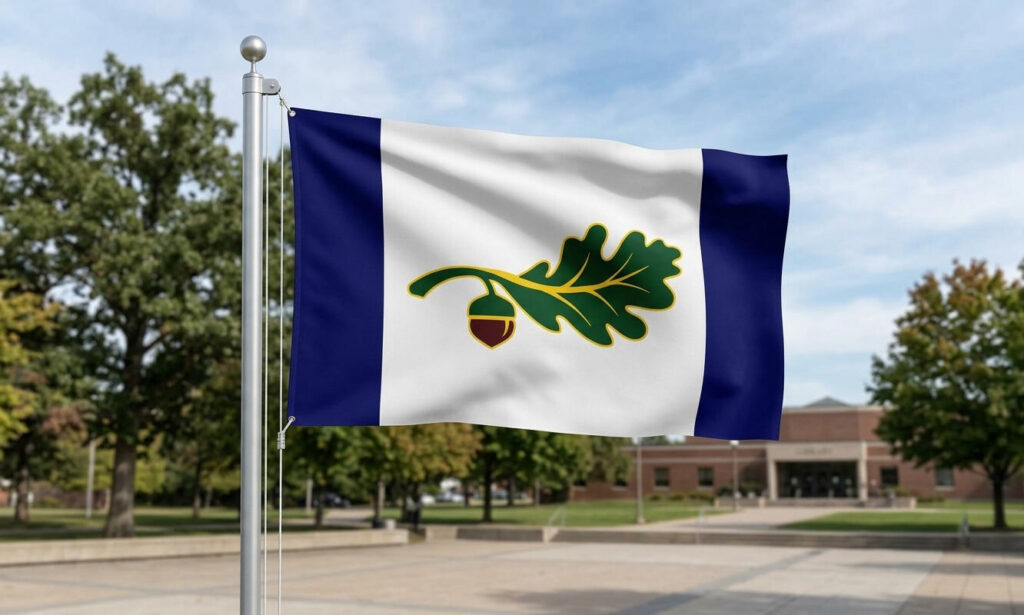
Take a moment and let it settle in, you probably have strong feelings about it, even I did when I first saw it. We have been taught since birth what our national flag is and that we should be proud of it, so it takes a great strength of conviction to even consider allowing another to take its place, but we also must weigh its values against our own, and consider how we want to be represented. This is an idea, not a certainty, much like my articles on a Federal UK, it is an option presented to provoke thought, not a demand to be executed. If the UK opened up recommendations to replace our existing flag, I would probably submit it, but such a decision needs to be made by the people as a whole, not by an individual. Now you’ve had a moment, let us discuss this flag.
Most people’s first thought is that it looks like a copy of Canada, there is some truth in that, but the Maple Leaf was groundbreaking at the time, the flag was so good it invented new vexillological terminology, which means that comparisons to it are more of a compliment than anything. Let’s run it through the rules, how does this flag represent its people? Well much as Maples are a very Canadian thing, the Oak is a very British tree, it is called the English Oak for a reason and it is probably the most well known tree there is. Britain has oaks growing pretty much everywhere, which is simply not true for most other nations as our climate is built for them, if it was much colder pines would dominate, if it was much warmer different species would take root. The oak has a very fundamental place in our history, it built our ancient ritual sites, our long halls, our ships, our bows, our entire society was built around the oak to such an extent that royalty set out special laws to prevent commoners simply chopping them down. I have a list of famous oak trees and their lore in a book on my bookshelf, and it is the only tree where when the grandest of them was pronounced dead earlier this year it made national news, the legend of Robin Hood still holds a special place in our hearts and the oak filled Sherwood Forest is a core part of that. Suffice to say oaks are a fairly universal feature of the British Isles, and they mean a great deal to the people, compare that to the Cross we are replacing, well while we are technically a Christian nation, the majority of our people are non-religious and thus it is not universal. In fact the variance between the British is so great, you won’t find much in the way of common symbols, so to some extent it makes sense it should be a feature of our landscape, and the importance of oaks is widespread going back at least as far as Ancient Greece. Some might argue that oaks are an English thing, but to that I say the parts of Britain that are not English are Celtic in nature, and oaks are sacred in druidic lore so it clearly is relevant to all of the UK.
So by chosing a single motif, we have not only achieved the first rule, we have unified the identity without needing to include lots of symbology and met the second rule. For the third people must feel connected to it, and the oak should go some way towards that, but we need something more tangible, and the flag is actually packed full of such detail. The idea of this flag of course was to represent the Federal UK, which of course is designed as a totally transparent high-trust state, and what could represent that better that the purity of a white background, that white is a promise to the people of a fair and equitable system where their opinions matter, but this is highly conceptual, what is not are the surrounding Navy Blue bands. The UK is an island, and while water extends in all directions for the most part the UK is a maritime nation trapped between two massive bodies of water, the North Sea and the Atlantic Ocean, these seas define everything about who we are, as they are our sources of trade and access to the entire world, without them an empire would not have been possible. The remaining rules pertain to the visibility and recognisability of the flag, and this flag uses dark colours on a white background producing excellent contrast and making it highly visible at a distance or in bad weather. Where concerns are greater are in its similarity to others, however, there are a lot of flags and only a limited number of ways to display things so some similarity is inevitable, the real question is, can you tell it apart?
There are a few flags that bare a passing resemblance to this flag, Canada we have already mentioned, but also tricolours the closest of which is France. So if you were to put the Canadian flag and this one together it would be plainly obvious they aren’t remotely similar as the Maple Leaf uses a very hot bright red whereas we have cool and dark colours so even in the dark it would be easy to tell them apart. For a moment though lets pretend a flagmaker accidentally made the Maple Leaf Navy Blue, there are still quite a few differences, the first is the type of leaf as it is an oak, but more importantly it is carrying an acorn to make the species clear and it is oriented differently. It should be noted this is about more than making it different, there was an earlier iteration with just a leaf oriented pointing up and it was still clearly distinct, but it had some orientation oddities. If you hang it vertically much like the Maple Leaf it actually looks a bit wrong, because the leaf is clearly oriented up, so the flag has a very clear up orientation that is ignored when hung vertically, by rotating the leaf 90 degrees and adding an acorn it grounds the symbol and mostly erases this problem, producing a flag with more comfortable utility. Something that is probably less noticeable is the ratios are different. In a tricolour the flag is split into three equal sized parts, but the Maple Leaf instead is in a ratio of 1:2:1 so the central “pale” (the correct heraldric name for a band of colour running down the centre) is twice the width of the sides meaning it is actually a 50-50 split between white and red. The Emerald Oak however uses a different ratio 1:2.1618:1, I call this the “golden pale”, the white pale is expanded to meet the Golden ratio in comparative area between white and blue, providing more room allowing for the length of the leaf, and creating a more modern spacious look. The Golden ratio is found in classical buildings and crucially in Georgian classical revival design, which tends to include most buildings of any significant power or wealth in the UK.
So that resolves similarities to Canada but what about France? At a glance you may not see the problem here either as they are very different, but the potential issues occur when the wind does not blow. Think about it, with the flag bunched up around the pole you won’t see the distinctive leaf, and France while a tricolour sports blue, then white and finally red. With only the first two to go on they could look nearly identical, however even when wrapped around the flagpole like this the difference in proportions will be visible and the difference is stark. Additionally you should still be able to see the colour of the tail end, and France’s red will give it away, whereas our blue follows a pattern that to my knowledge you just won’t see in other flags. That’s excellent, so this flag passes all the tests and even one subjective one I’ve always considered crucial, we must be able to teach this identity to our children and for that the flag should remain simple enough a young child could draw it close enough as to be recognisable as the flag. I think they definitely could, they may not get the proportions or the leaf lobes exactly right, but the leaf, the acorn and the bands should easily provide enough detail to correctly identify this flag.
A note on colour, amusingly the Emerald Oak isn’t actually Emerald, I did trial it out initially but it was too bright and looked off. The colour of the leaf I instead chose as British Racing Green which has quite a legacy of its own and seemed to perfectly fit the look I was going for while still being arguably “Emerald” in colour. The colours more generally were carefully chosen for their meaning, firstly the UK it seems as discussed in the article is made up of three significant groups, the Celtic nations, the Viking North, and the Wessex South. The green was chosen to represent the Celtic nations, the Viking North was more complex, they traditionally are very socialist and so early experiments were with red, but it was too contrasting and gave the wrong message, so instead the maritime Navy Blue seemed to represent them better. The golden accents on the leaf is a nod to the South, as historically they were represented by a golden dragon, and more conventionally it is the colour of their golden grain fields. Politically these colours also have relevance, the white is a neutral colour of the status quo, proclaiming the intent to only change that which needs to be changed and leave what works. Blue is traditionally the colour of the Conservatives, only here it is more harking back to the small “c” conservatives of the past, the defenders of small governance, market freedom, frugality and common sense. Red was problematic not least because of the contrast, while commonly thought of as a socialist colour, it is also tied in to communism and revolution, anyone who knows the YPF knows we don’t seek rash calls to action to dethrone the current power structures, because its just not conducive to stable governance. Instead green is a more subtle centrist approach focused more on reformation than revolution, in a steady march to improve and fix what is broken. Yellow is more commonly thought of as centrism these days, however the Liberal Democrats are not overly popular these days due to general feeling from many of betrayal, more than this their views do not align well with my own and they are often considered to be academic elitists who spend too much time in ivory towers, and none of that is conducive to the sort of message we are trying to send.
So that is the flag, and the explanations around it, hopefully this more raw section gives you a bit of insight into how I construct these articles and the complex nature of the problems we face. I would love to see alternative options for flags or even how we might devolve the state and make it workable for all.