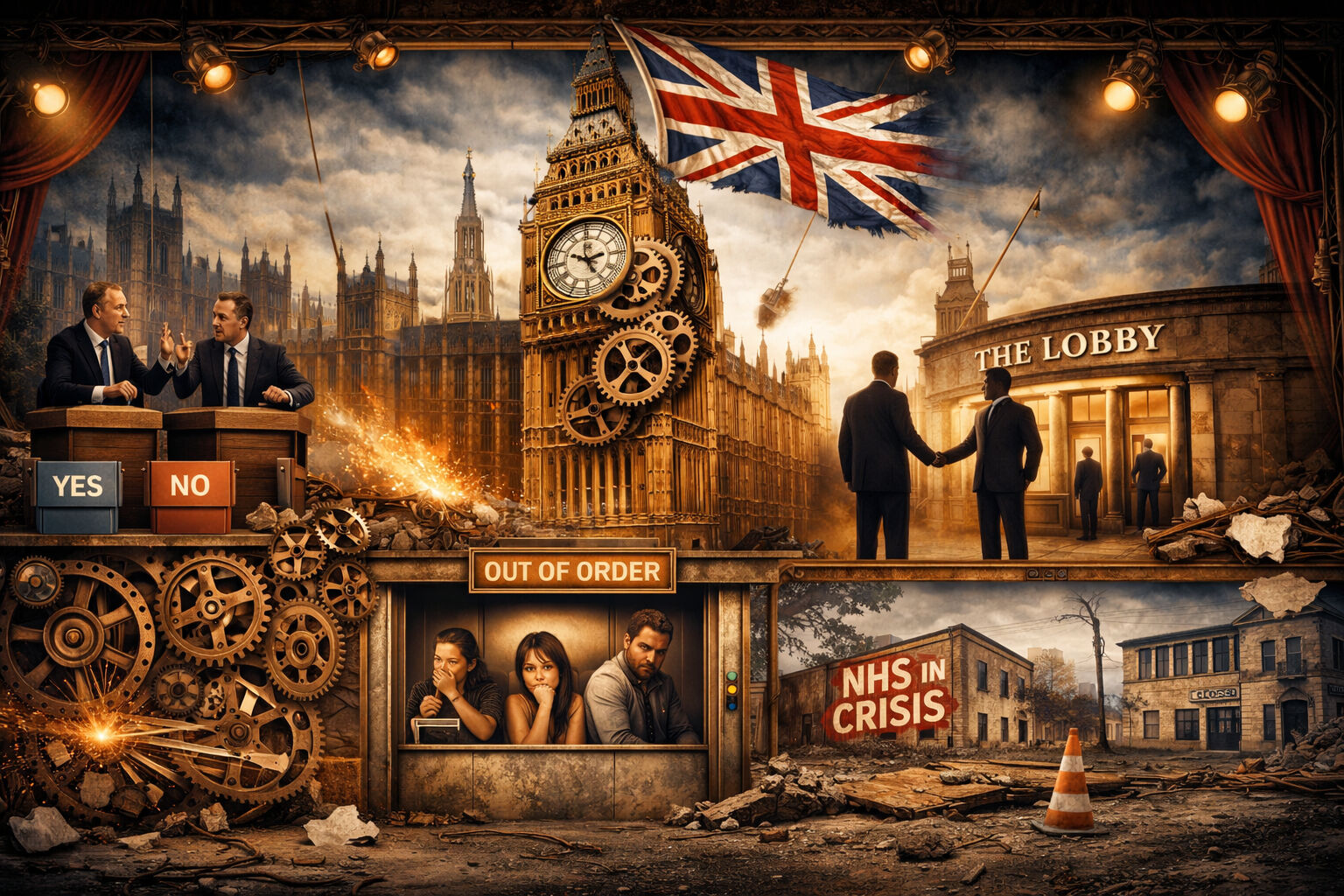
The Stage of Discord

Modern corruption in Westminster rarely takes the form of brown envelopes; it is far more polite, codified in the language of “professional services.”. It is the seamless transition from the heights of public office to the boardrooms of the private sector.

Continue Reading →

The Hyper-Centralisation Trap: Power Disconnected from People

The UK governance model is afflicted by a toxic, chronic condition: hyper-centralisation. This is not merely an accident of history but the deliberate, sustained effort of an overarching political class convinced of its own superior knowledge.

Continue Reading →

The Engineered Silence: Why the Democratic Deficit Mutes the People’s Voice

The widely perceived crisis of public trust is not an unfortunate side effect of modern governance; it is a necessary condition for the preservation of the status quo. The true mechanism by which the political elite maintains control is the Democratic Deficit. This deficit is not accidental; it is a profound, structural gap between the promise of representative democracy and the practical reality of citizen power.

Continue Reading →

The Silence of Cynicism: How Weaponized Distrust Undermines the Democratic Mandate

The decline in public confidence is a statistical freefall, quantifiably demonstrating that citizens doubt their leaders’ intent and competence. This decline represents a collapse of both transactional trust (belief in the government’s ability to deliver services) and, more dangerously, generalized trust (belief in the inherent honesty and integrity of the political class itself).

Continue Reading →

The Thirty-Year Deception: How Britain Lost Its Voice and Traded Choice for Consensus

The crippling of the unions had an immediate and devastating effect on the Labour Party, the supposed voice of the common man. Losing its traditional funding stream and core identity, the party undertook a fundamental transformation designed not to reclaim its socialist roots, but to court the very corporate interests that had bankrolled its rival’s success.

Continue Reading →

An Oath for a Better Tomorrow: Why the Bell Principles Should Bind All UK Politicians

Public faith in Parliament is at an all-time low, fueled by a relentless stream of financial scandals, ethical lapses, and a general sense of political exceptionalism. The current system relies on internal party mechanisms and non-binding parliamentary codes of conduct, which notoriously lack real teeth.

Continue Reading →

A Global Governance Tour: Lessons for the UK 🇬🇧

This is a journey to understand how other successful democracies organize themselves, and what lessons they might hold for the UK, including the powerful examples of consensus from Switzerland, Belgium, and the Netherlands.

Continue Reading →

The Apathy Epidemic: A Crisis of Disconnection 🗳️

The average person feels they have no control over the government or its actions. This isn’t a paranoid delusion; it’s a lived reality directly supported by data. For many, their vote feels meaningless

Continue Reading →

The Crisis of Legitimacy: An Anatomy of Public Discontent

The scope of the UK’s legitimacy crisis is breathtaking, growing with a corrosive pace that our political institutions are ill-equipped to address. The emotional and psychological toll on citizens has become immense, fostering a disconnection that threatens the very integrity of our political compact.

Continue Reading →

The Hegelian Straitjacket: A Blueprint for New Politics

Ultimately, the Left-Right debate is an irrelevant argument about who should be in charge. The left and the right are simply two different groups vying for control of the same broken system, only further exacerbated by the fact that here in the UK the left are really the right by another name

Continue Reading →