
How to Scatter, Restructure, and Rebuild Civil Administration
In Constructing the Federal UK, we established the constitutional architecture and regional blueprint of a high-trust federation. We drew the boundaries of the Twelve Sovereign Regions and Four Isolated Metropolises, established the Schulze STV electoral system, and mapped out the 50-30-20 bottom-up fiscal mechanics that permanently prevent regional exploitation.
However, writing a new constitution is only half the battle, an architecture on paper is worthless if the engine room of the old order remains intact.
Beyond the visible debates of Parliament lies the true sovereign power of the modern British state, the invisible, permanent administrative class of central rule: Whitehall. For over a century, elected ministers have come and gone like passing shadows, while the permanent mandarins of the Civil Service have maintained an unbroken monopoly over policy, finance, and implementation. The senior civil service, the Treasury mandarins, and the departmental directorates in SW1 have functioned as an untouchable administrative oligarchy. They outlast politicians, control the flow of information, absorb political reforms, and quietly strangle any policy that threatens their central monopoly.
If we attempt to build a federal republic while leaving the Whitehall machine in SW1, the permanent state will quietly choke the federation in its cradle. It will leak, stall, fabricate administrative friction, and drag power back to London through regulatory complexity. We can write a new constitution but if we don’t dismantle Whitehall, the best we can hope for is to sit and watch while the subvert the new federation from within. To guarantee the survival of a federal Britain, we must pick up the scalpel and systematically dismantle, disperse, and rebuild the permanent administrative machine.
To make federalism real, the state itself must be federalized. We must dismantle the unitary civil service, smash the Treasury monopoly, disperse administrative functions across the soil of the island, and construct a transparent, domain-embedded public administration.
Part I: Forensic Diagnosis: How Whitehall Murdered the Free State
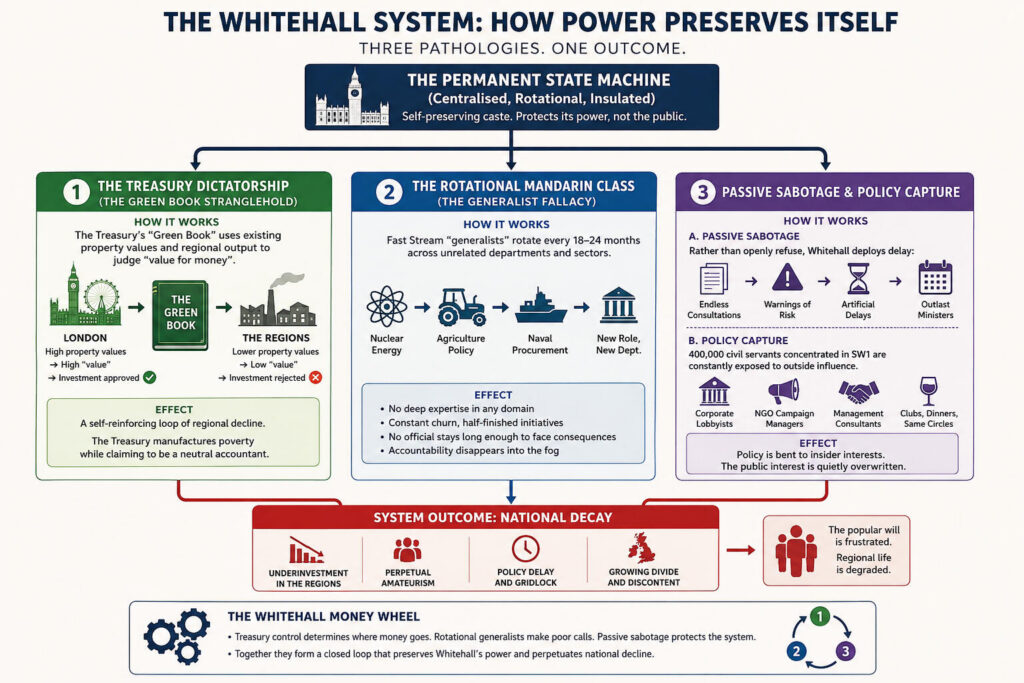
Before we can rebuild public administration, we must understand how the current machine operates. The British Civil Service prides itself on “impartiality” and “administrative continuity.” In reality, its structure creates an insular, self-serving bureaucracy designed to frustrate the popular will and degrade regional life. Whitehall is not a neutral instrument waiting for political instructions; it is a self-preserving caste defined by three systemic pathologies.
1. The Treasury Dictatorship (The Green Book Stranglehold)
The HM Treasury is not merely a finance ministry; it is an ideological oligarchy that exercises absolute veto power over every square inch of public life. Through its internal valuation formulas – most notably the infamous “Green Book” – the Treasury evaluates public investment based on existing property values and regional economic output.
This creates a self-reinforcing loop of regional decline: because London property values are hyper-inflated, a transport project in London automatically yields a high “net present value,” justifying billions in public expenditure. Because a northern town high street or Cumbrian rail link sits in a lower-value economy, the Treasury formula deems investment “uneconomic.” The Treasury does not manage national wealth; it actively manufactures regional poverty while claiming to be a neutral steward of public accounting.
2. The Rotational Mandarin Class (The Generalist Fallacy)
The Home Civil Service Fast Stream is built on the Victorian myth of the “gifted generalist” – the belief that an Oxford-educated administrator can manage the nuclear energy grid on Monday, move to agricultural policy on Thursday, and oversee naval procurement six months later without holding a shred of technical or practical domain knowledge.
This creates a culture of perpetual amateurism. Civil servants rotate through roles every 18 to 24 months to secure promotions, leaving behind a wake of half-finished initiatives, unscrutinized contracts, and institutional amnesia. Because no official remains in post long enough to face the consequences of their failures, accountability disappears into the administrative fog.
3. Passive Sabotage and Policy Capture
When presented with political directions that threaten its centralist worldview, Whitehall rarely engages in open refusal. Instead, it deploys passive sabotage. It generates labyrinthine consultations, warnings of regulatory risk, and artificial implementation delays designed to outlast the tenure of incoming ministers.
The fundamental flaw of Whitehall is not the competence of individual civil servants; it is the physical concentration, it creates a single captive audience, vulnerable to its own environment. With 400,000 civil servants trapped in SW1, they are exposed to continuous, unmonitored capture by metropolitan lobbies, NGO campaign managers, and management consulting firms who walk the same corridors. When thousands of administrators share the same London clubs, commute on the same train lines, and raise their children in the same suburban enclaves, they inevitably develop a shared class interest. They come to view the rest of the United Kingdom not as a collection of sovereign communities, but as a vast, unruly province to be managed, taxed, and occasionally placated with token grants. The public interest is quietly replaced by the insider consensus of the London ring-road.
To break this monoculture, we must abolish the concept of a centralized Civil Service. The administrative apparatus must be permanently fractured and distributed across the sixteen federal entities of the realm.
Part II: The Four Pillars of Civil Service Reconstruction
To eradicate these pathologies, we must replace the unitary permanent state with a decentralized, domain-rooted administrative network.
Pillar 1: Dissolution of the Unitary Home Civil Service
The unitary “Home Civil Service” is permanently abolished as a single legal entity. In its place, administrative authority is divided into Twelve Regional Civil Corps and Four Metropolitan Administrations.
- Local Recruitment and Rooted Tenure: Civil servants will be hired directly by regional governments from the communities they serve. The central “Fast Stream” scheme in London is disbanded.
- Abolition of Perpetual Rotation: Administrators must build long-term careers within specific functional domains (e.g., water infrastructure, agricultural logistics, naval procurement). A civil servant managing flood defenses in Lincolnshire will remain in Lincolnshire, building decades of local ecological and engineering expertise.
Pillar 2: Physical Departmental Dispersion
The central state departments will be physically relocated out of London and dissolved into their corresponding geographic heartlands. More on this later.
When civil servants live, work, and educate their children in the regions affected by their policies, the cold, abstract indifference of SW1 governance vanishes.
Pillar 3: Stripping the Treasury Monopoly
The HM Treasury in Whitehall will be stripped of its discretionary spending veto over the provinces.
Under the Bottom-Up Fiscal System ($50/30/20$ Rule), taxes are collected locally at the source. Fifty percent remains in the regional treasury immediately, thirty percent enters the protected National Remunatory Fund, and twenty percent is remitted to the Federal Senate Treasury in Manchester strictly for national defense, diplomacy, and common infrastructure.
The Treasury ceases to be a central dictator distributing pocket money to supplicants. It becomes a technical clearinghouse for federal accountancy, stripped of any statutory authority to block provincial capital projects.
Pillar 4: The Scrutiny Panopticon
To prevent regional civil services from forming localized corrupt networks, the Federal Office of the Public Scrutineer is established in Belfast.
Operating under strict statutory transparency rules:
- Every official email, procurement contract, policy memo, and financial transaction across all sixteen capital hubs must be published in real-time, searchable open registries accessible to all citizens.
- Off-the-record meetings between civil servants, corporate lobbyists, or politicians are reclassified as High Fraud, carrying penalties that may include immediate dismissal, pension forfeiture, and even imprisonment, depending on the level of collusion and its potential threat to the state.
Part III: The Five Levers of Power
We have already outlined the structed of the Federal UK, and with it the institutions that run it. Legislative power resides with the regional parliaments, metropolitan assemblies and the federal senate, all elected fairly and proportionally by the people as described in the previous article. Executive power then resides with a slimmed down cabinet of senate ministers headed by a prime minister, much as it already does, but with executive decisions limited strictly to emergency response and military coordination. This allows the country to both deliberate and take swift action when necessary, but with all this slimming down, where has all that power gone?
Power is not merely wealth or might; it derives its sovereignty from the individual, and so power is derived from human nature itself. A stable state must satisfy our physical needs (survival and defense), our mental needs (rational law and order), our moral and secular values (ethics and social decency), our monetary requirements (financial discipline), and our need for unblinking public oversight.
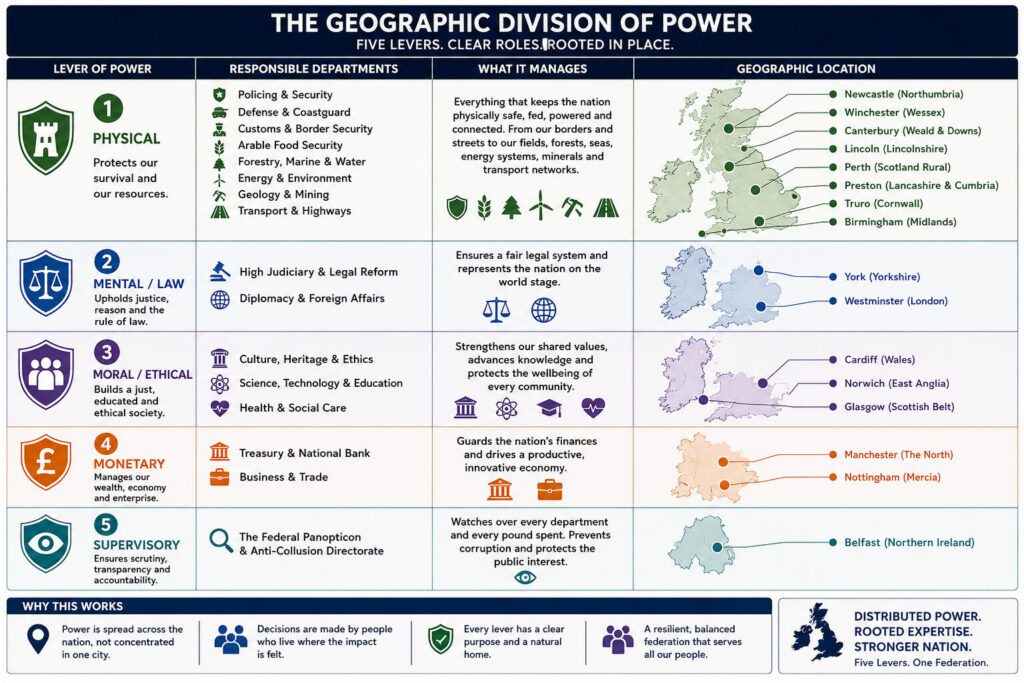
To prevent any single institution from becoming a tyrant, we distribute these five organs of state across the geography of the realm, matching each department to the natural strength and character of its soil:
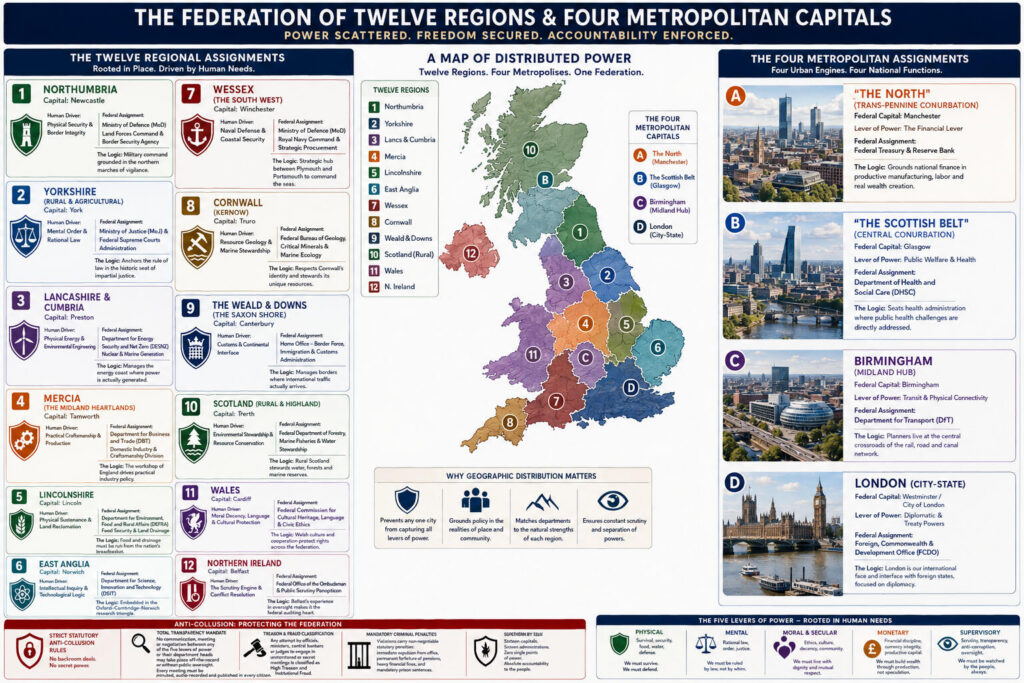
1. The Four Metropolitan Departments
The four isolated urban hubs steward specialized, high-density macro-functions:
- Greater London (Seat: City of London) – Department of Diplomacy & Foreign Relations: Stripped of internal domestic authority, London retains jurisdiction over international diplomacy, embassy accreditation, consular services, and foreign treaties under the direct oversight of the Federal Senate.
- The Northern Conurbation (Seat: Manchester) – Department of Economics & Taxation: The Treasury and Central Bank are uprooted from SW1 and established in the industrial engine-room of the North. Currency creation, national tax policy, and capital allocation are permanently tied to manufacturing and real production rather than speculative London real estate.
- Birmingham Metro (Seat: Birmingham) – Department of Transport & Connectivity: Placed at the central crossroads of the UK, managing national rail corridors, freight networks, motorway logistics, and port connectivity. The heart of the network is responsible for mass transit and infrastructure networks, from canals, rails and roads, to linking up the national grid, fibre optics and other services.
- The Scottish Belt (Seat: Glasgow) – Department of Health & Social Care: Located in the central Scottish urban corridor, anchoring national public health standards, pharmaceutical research, medical technology regulation, and social care frameworks in a world-leading life-sciences hub.
2. The Twelve Sovereign Regional Departments
The twelve historic provinces house the core operational departments of the nation:
- Northumbria (Seat: Newcastle) – Department of Policing & Security: Placed in the ancient northern march, where internal security of the realm has long been at the forefront. Overseeing all internal security matters, from policing and prisons, to developing national cyber and information security infrastructure and standards, protecting the citizens from anyone that might do them harm.
- Yorkshire (Seat: York) – Department of Rights & Justice: Placed in the historic seat of Northern jurisprudence, overseeing legislative drafting, federal courts, judicial appointments, prison administration, and constitutional civil rights.
- Lincolnshire (Seat: Lincoln) – Department of Agriculture & Fishing: Located in the nation’s primary food bowl, managing arable land security, soil conservation, agricultural technology, fishing regulations, crop yields, and river basin drainage.
- Scotland Rural (Seat: Perth) – Department of Environment & Water: Based in Perth, stewarding wilderness conservation, national parks, forestry reserves, lakes and river stocks, pollution regulations and environmental management.
- Lancashire & Cumbria (Seat: Preston) – Department of Energy & Grid Resilience: Placed at the core of Nuclear and Renewable development in the Northwest, stewarding geothermal research, offshore wind, solar, tidal and hydro energy development, nuclear management, and national grid stability. Tasked with the phasing out of fossil fuels, and ensuring the it is replaced with viable alternatives.
- Mercia (Seat: Nottingham) – Department of Industry & Manufacturing: Centered in the historic industrial heartland, overseeing heavy engineering, material science, industrial automation, and manufacturing supply chains. Managing commercial regulation, corporate standards, domestic market integration, and small-business frameworks.
- East Anglia (Seat: Norwich) – Department of Science, Innovation & Technology: Located in the fiercely independent eastern province and crucible of innovative development in Britain, stewarding scientific grants, space research, and technological standards. Crucially this department contains the Department of Education, ensuring that minds of tomorrow are given the best chance, being taught by the greatest minds of today.
- Wessex (Seat: Winchester) – Department of Science & Technology: Situated amidst the extensive southern ports and aerospace corridor, managing armed forces, military procurement, classified intelligence, army bases, naval dockyards, territorial sovereignty, and state level cyber-defense infrastructure.
- Wales (Seat: Cardiff) – Department of Culture & Heritage: Placed in the Welsh capital, managing national heritage, language preservation, arts funding, historical monuments, and secular ethical standards. Everything from archaeology to documentation and preservation of regional accents, food, music and dance comes through this department.
- Northern Ireland (Seat: Belfast) – Department of Surveillance & Integrity: Located in Belfast, containing the Federal Office of the Ombudsman and the Public Scrutiny Panopticon. Belfast’s hard-won experience in cross-community oversight, rights protection, and restorative justice makes it the absolute ideal home for the central auditing body that scrutinizes the entire federal state. This department manages electoral hygiene (Schulze STV monitoring), federal civil service standards, public records, and the monitoring of the state as a whole. They ensure that even the highest levels of politics are still held accountable, and that collusion is rooted out. Additionally they control the rules and regulations surrounding surveillance by the state itself, such as by the police on the citizens, to ensure the need is valid, necessary and limited, to ensure freedom from state oppression.
overseeing border security, customs enforcement, federal policing standards, anti-smuggling operations, and immigration control.
- Cornwall / Kernow (Seat: Truro) – Department of Geology & Marine Ecology: Placed in the Southwestern peninsula, where these things are found in abundance respecting Cornwall’s distinct identity while placing critical resource strategy in the hands of historic mining and fishing communities. This department oversees mining and drilling permits, geological research, water table management, and deep sea marine stocks.
- The Weald & Downs (Seat: Canterbury) – Department of Customs & Immigration: Based in Canterbury the original Gateway to Europe, governing the border reality along the coast where international traffic actually arrives. Managing the nations border force, customs regulations, immigration, asylum housing and monitoring, foreign national integration and citizenship requirements and testing, letting the heart of the English and British identity define what it means to be British.
Checks and Balances: The Five-Fold Separation of Powers
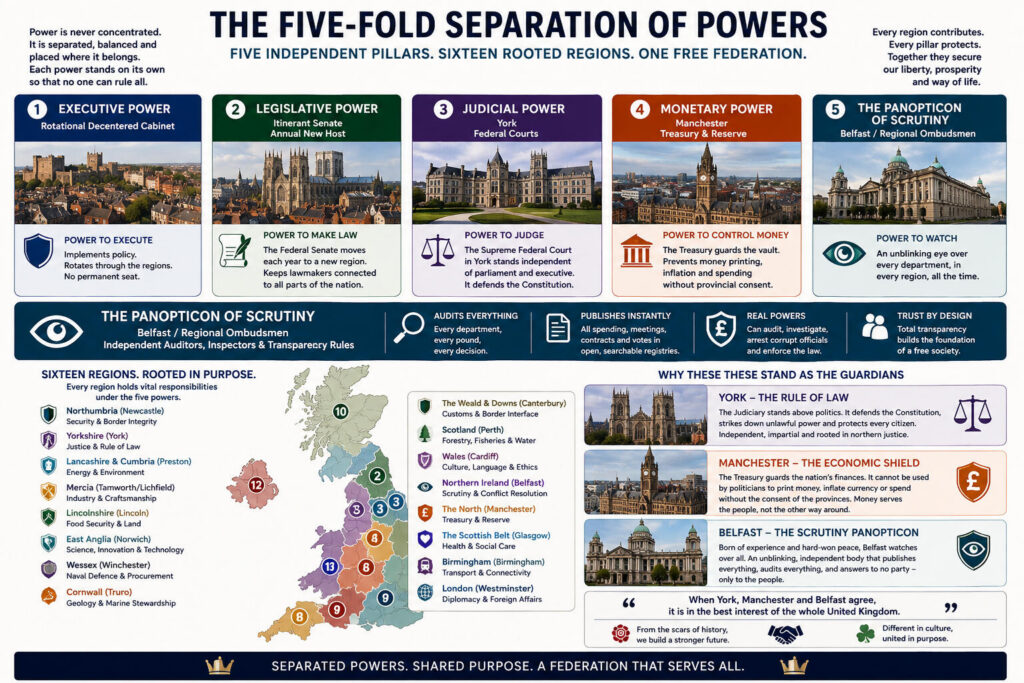
So we see that all 16 regions have a role to play in these five levers of power whether that be security as in Northumbria, Wessex and the Weald & Downs, protecting our natural resources as with Cornwall, Lancashire & Cumbria, or Scotland, or simply protecting our way of life as you’ll find in Wales or Northern Ireland. Each role is just as important as they each bring something to the table that is a core part of what it means to be British. Of course three of these stand out in their nature:
- The Judiciary (The Rule of Law): Centered in York, the Supreme Federal Court is entirely independent of parliament. It holds sole authority to strike down laws that violate the written Federal Constitution.
- The Federal Treasury (Economic Shield): Centered in Manchester. The Treasury controls the vault, preventing executive politicians from printing money, inflating currency, or spending without provincial consent. Protecting the people’s finance from being stolen for the whims of the current administration.
- The Scrutiny Panopticon (Visibility & Trust): Headquartered in Belfast with branches in every region. This independent, non-political body operates an unblinking inspection system over all government officials. Unlike the totalitarian panopticon designed to spy on the citizen, this system turns the camera around. Every public expenditure, official meeting, procurement contract, and legislative vote is published instantly in open, searchable registries. The Scrutineers have statutory authority to audit any department, arrest corrupt officials, and present findings directly to the public. By making government totally transparent, we establish the bedrock of trust required for a free, high-trust society.
It is no coincidence that these three are some of the most contentious in British history, practically everyone has heard of the War of the Roses, and how it turned families against themselves. Those scars run deep, even in today’s England, and it is rare to see York and Manchester in agreement unless they are banding together against the greater threat of London. If these two stubborn old beasts can agree on something, then it is probably in the best interests of the entire United Kingdom. Meanwhile Northern Ireland makes no secret of their dislike of the English, and nobody would blame them after what they’ve been through. Who better to scrutinize all the dealings of the nation than those with an inherent distrust of it? As possibly the most surveilled part of the nation they also know what it is like to live under such scrutiny and how to use it to the benefit of all rather than blatant spying without cause.
Part IV: Adversarial Stress-Test: Addressing the Centralist Objections
When this plan is published, the defenders of the permanent state will launch a series of predictable counter-attacks. Any proposal to dismantle Whitehall will face immediate, fierce resistance from the political and administrative establishment. We must anticipate their core objections and dismantle them before they can take root.
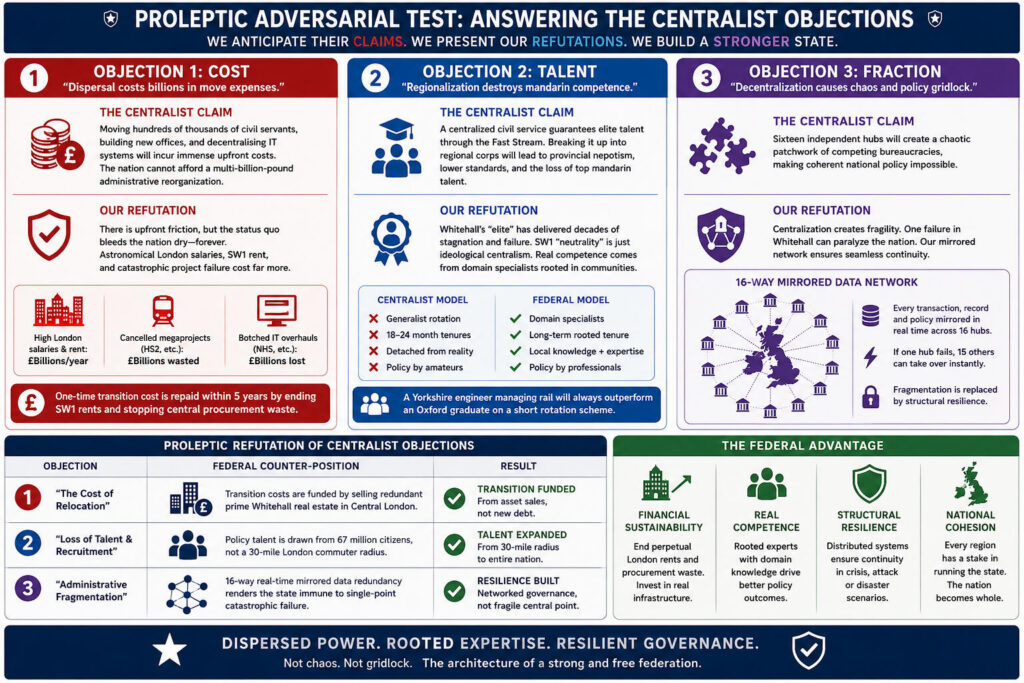
Objection 1: The Transition Cost and Logistical Friction
- The Centralist Claim: “Admittedly, dispersing hundreds of thousands of civil servants, building new regional administrative offices, and decentralizing IT systems will incur immense upfront transition costs. Physically moving sixteen departments out of London will cost billions in new construction, technology infrastructure, and severance pay. In a time of fiscal strain, the nation cannot afford a multi-billion-pound administrative reorganization.”
- The Refutation: To be sure, moving administrative hubs out of London involves initial logistical friction. But this one-time operational transition must be weighed against the crushing, perpetual cost of maintaining the status quo. Central London contains some of the most expensive commercial and residential real estate on earth. The central state currently occupies millions of square feet of prime real estate across Westminster, Whitehall, and Victoria. The state currently pays astronomical London-weighting salaries and billion-pound lease rents for hyper-expensive SW1 office blocks. More critically, the centralized state loses tens of billions every year in misallocated capital – from cancelled megaprojects like HS2 to botched NHS IT overhauls driven by SW1 insularity. The transition pays for itself within five years by eliminating London real-world estate rents and stopping central procurement waste.
Under our plan, these historic buildings are vacated, auctioned off, or converted into public museums and revenue-generating municipal leases. The sale of a single block of Whitehall offices easily pays for the construction of modern, energy-efficient administrative headquarters in Preston, Lincoln, or Perth. The transition is not a cost; it is a massive real estate liquidity event that funds the physical construction of the federation.
Objection 2: The Loss of Civil Service Talent and Neutrality
- The Centralist Claim: “London is the nation’s talent hub. You cannot recruit world-class economists, scientists, and administrators if you force them to live in the provinces. A centralized Civil Service guarantees a high baseline of administrative talent through competitive national recruitment like the Fast Stream. Breaking it up into regional corps will lead to provincial nepotism, lower standards, and the loss of elite mandarin talent.”
- The Refutation: This argument rests on circular, arrogant reasoning. London appears to hold a monopoly on talent only because Whitehall has spent a century requiring talented individuals to move to London if they wish to serve their country.
Defenders of the Fast Stream cling to an illusion of mandarin competence that is daily contradicted by reality. The “elite talent” of Whitehall has presided over thirty years of regional stagnation, crumbling infrastructure, and public service collapse. What the centralist calls “neutrality” is merely an unthinking ideological commitment to SW1 centralism. Replacing generalist careerists with domain specialists hired directly from local communities restores genuine competence. A civil engineer raised in Yorkshire managing regional rail networks will always outperform an Oxford history graduate rotating through the Department for Transport on an eighteen-month graduate placement.
By dispersing departments across the sixteen regions, we open public service to the entire nation. A brilliant economist who prefers to raise a family in Lancashire can work for the Treasury in Manchester; a top marine biologist can work for the Environment Department in Perth without abandoning their research waters. Dispersal expands the talent pool from a 30-mile London commuter radius to 67 million people.
Objection 3: Regional Fragmentation and Administrative Gridlock
- The Centralist Claim: “Splitting administrative departments across sixteen distinct cities will create chaos, communication breakdowns, and administrative paralysis. If you divide civil administration across sixteen independent hubs, you create a chaotic patchwork of competing bureaucracies, making coherent national policy impossible.”
- The Refutation: This objection mistakes centralized uniformity for operational efficiency. The centralized Whitehall model is itself a fragile, single-point-of-failure liability. Under the unitary state, a major power failure, a single cyber-attack, administrative failure, strike, or physical crisis in Whitehall can paralyze the nation as the entire British state grinds to a halt.
Under our federal architecture, every regional department operates on a shared, encrypted 16-Way Mirrored Data Network.
- Every administrative transaction, legal record, tax entry, and policy document processed in Newcastle or Lincoln is instantly mirrored across secure server nodes in all fifteen other provincial capitals.
- If a disaster strikes the Department of Transport in Preston, fifteen other hubs possess real-time, redundant capabilities to take over federal administrative functions seamlessly. The Department of Energy in Truro or the Department of Justice in York can immediately assume administrative load without losing a single line of state data.
Fragmentation is replaced by network resilience. Distributed governance is not fragmentation; it is structural resilience.
Conclusion: Chaining the Leviathan
We do not underestimate the magnitude of this task. The permanent state in Whitehall will not surrender its century-old monopoly voluntarily and it will never consent to its own demise. It cannot be persuaded, reformed, or gently re-educated. It will argue that centralism is efficient, that regional dispersion is chaotic, and that the public is better served by elite administrators in London than by their own local assemblies.
We reject this master-servant dynamic entirely. It must be systematically dismantled by a sovereign act of the public will.
The centralized civil service is an outdated imperial relic that has reduced a great nation to stagnation and provincial decay. By dismantling the Civil Service, dispersing departments into their natural geographic heartlands, stripping the Treasury of its financial veto, and enforcing total public transparency from Belfast, we shatter the SW1 monopoly forever.
We clear away the rotting timber of the mandarin class, and in its place, we build a modern, high-trust, federal administration that belongs to the people who inhabit the soil of this island.
By scattering the sixteen primary Departments of State across our twelve historic provinces and four isolated metropolises, we do not simply move desks; we restore administrative sovereignty to the soil of the nation. We force politicians and administrators to live alongside the people they serve, ground our state levers in moral and physical reality, and render the British state immune to central tyranny.