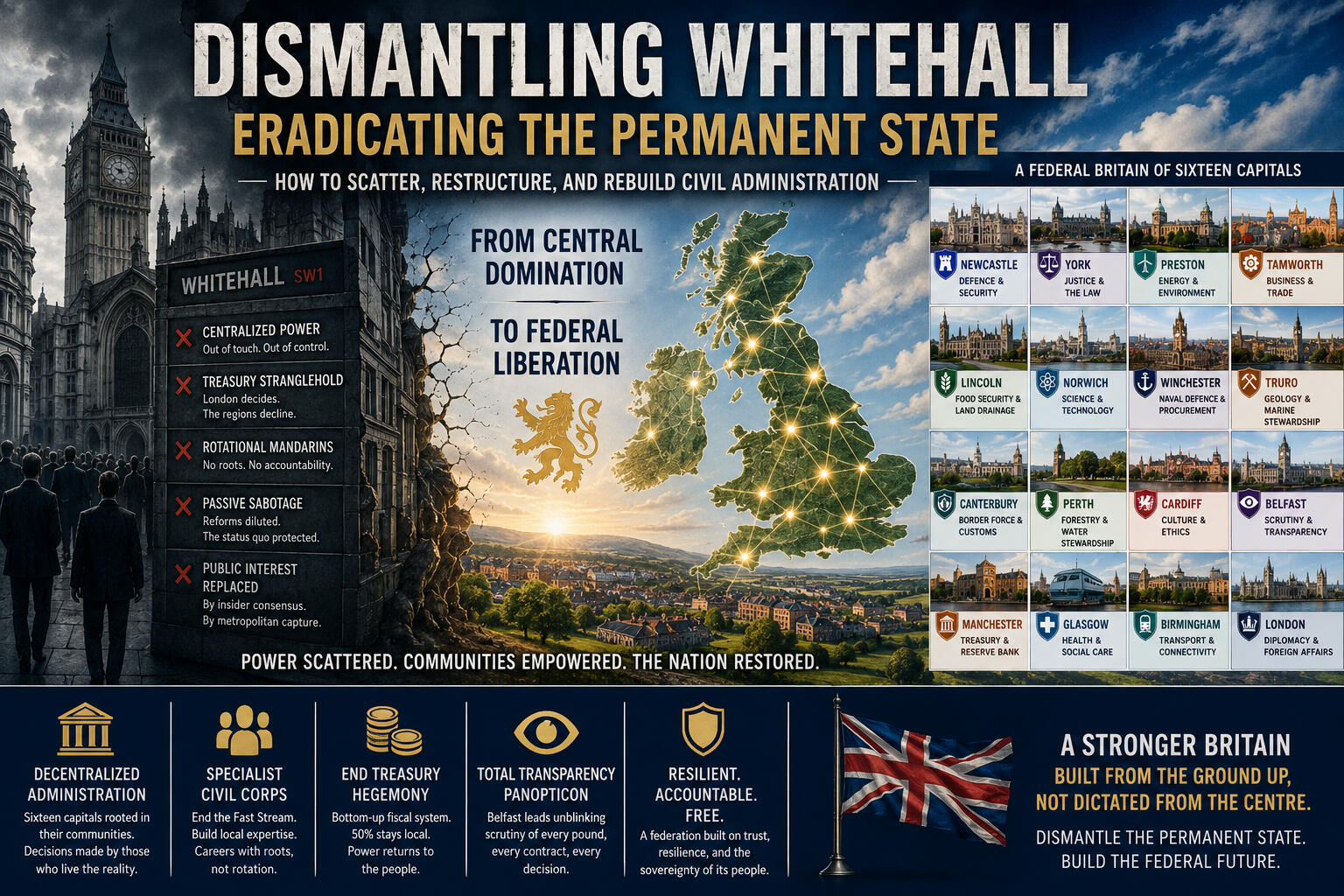
Dismantling Whitehall: Eradicating the Permanent State

Whitehall is not simply a collection of government offices; it is a highly centralised administrative system with its own incentives, institutional memory, and concentration of power. This article argues that a federal Britain cannot survive while that machinery remains intact, and proposes replacing the unitary civil service with a geographically dispersed network of regional and metropolitan administrations. Departments are rooted where their work actually happens, the Treasury is relocated away from London, specialist expertise replaces perpetual bureaucratic rotation, and an independent scrutiny system makes government radically more transparent. The result is intended to be a state that is less concentrated, more locally knowledgeable, more resilient to failure, and ultimately more accountable to the people it serves.


Continue Reading →

The Engineered Silence: Why the Democratic Deficit Mutes the People’s Voice

The widely perceived crisis of public trust is not an unfortunate side effect of modern governance; it is a necessary condition for the preservation of the status quo. The true mechanism by which the political elite maintains control is the Democratic Deficit. This deficit is not accidental; it is a profound, structural gap between the promise of representative democracy and the practical reality of citizen power.

Continue Reading →

The Constitutional Mandate for Adaptive Governance: Securing Liberty Against Exponential Technological and Ecological Shock

The core harm of this system is the moral catastrophe of dissolution: the failure of a fixed framework to safeguard the sacred rights of property, security, and liberty from threats that operate on a technological, not political, timeline. The governing instruments, conceived during the Enlightenment era, were primarily designed to check political power and defend against tyranny. Today, the state faces exponential, non-human, and systemic threats, from hyper-automation to climate collapse, which traditional amendments and policy debates are tragically slow to address.

Continue Reading →

The Philosopher’s Blueprint: A Cast-Iron Constitution for the 21st Century

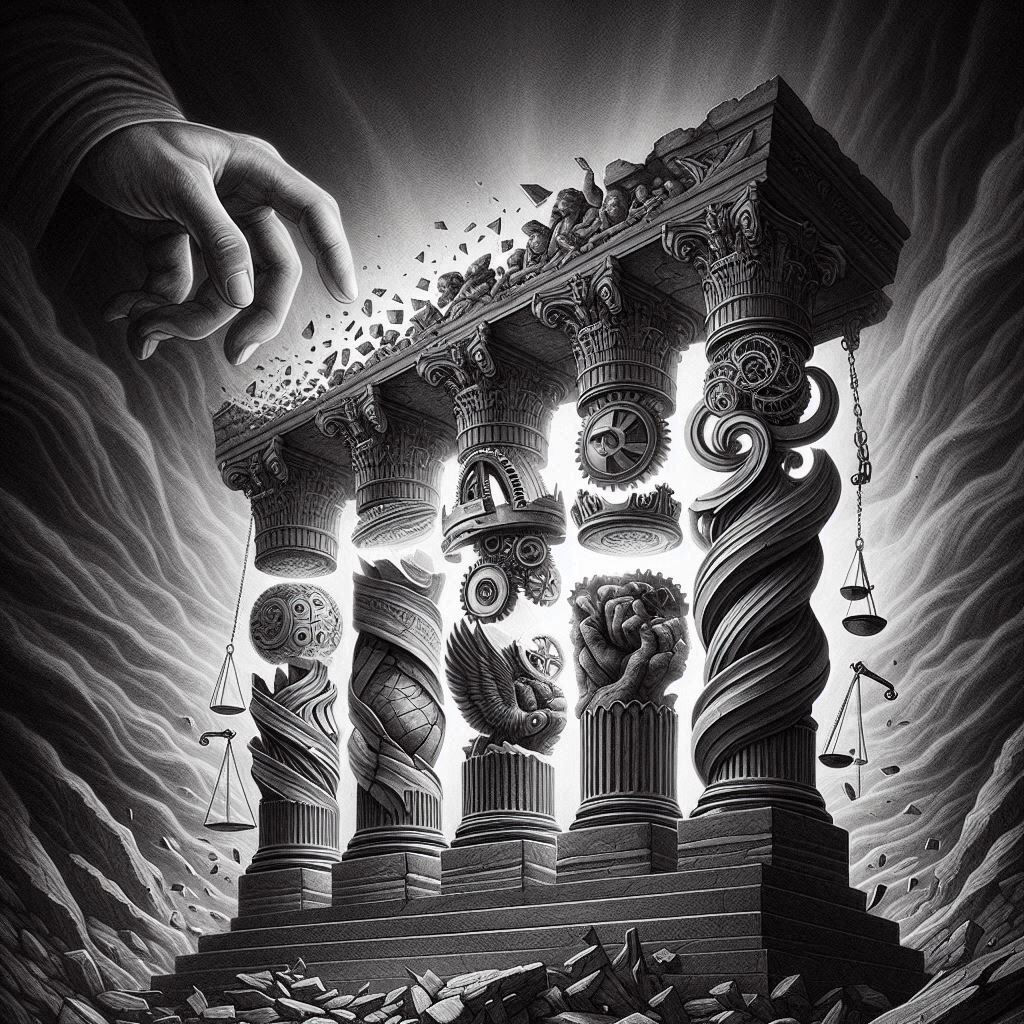
We need a new, modern, written Instrument of Government—a cohesive blueprint—that draws on the lessons of the past and finally confronts these unresolved tensions head-on. This confrontation demands a complete architectural overhaul, moving beyond the traditional tripartite separation of powers to institutionalize a new, autonomous Fourth Pillar designed to safeguard economic stability and institutional integrity.

Continue Reading →