
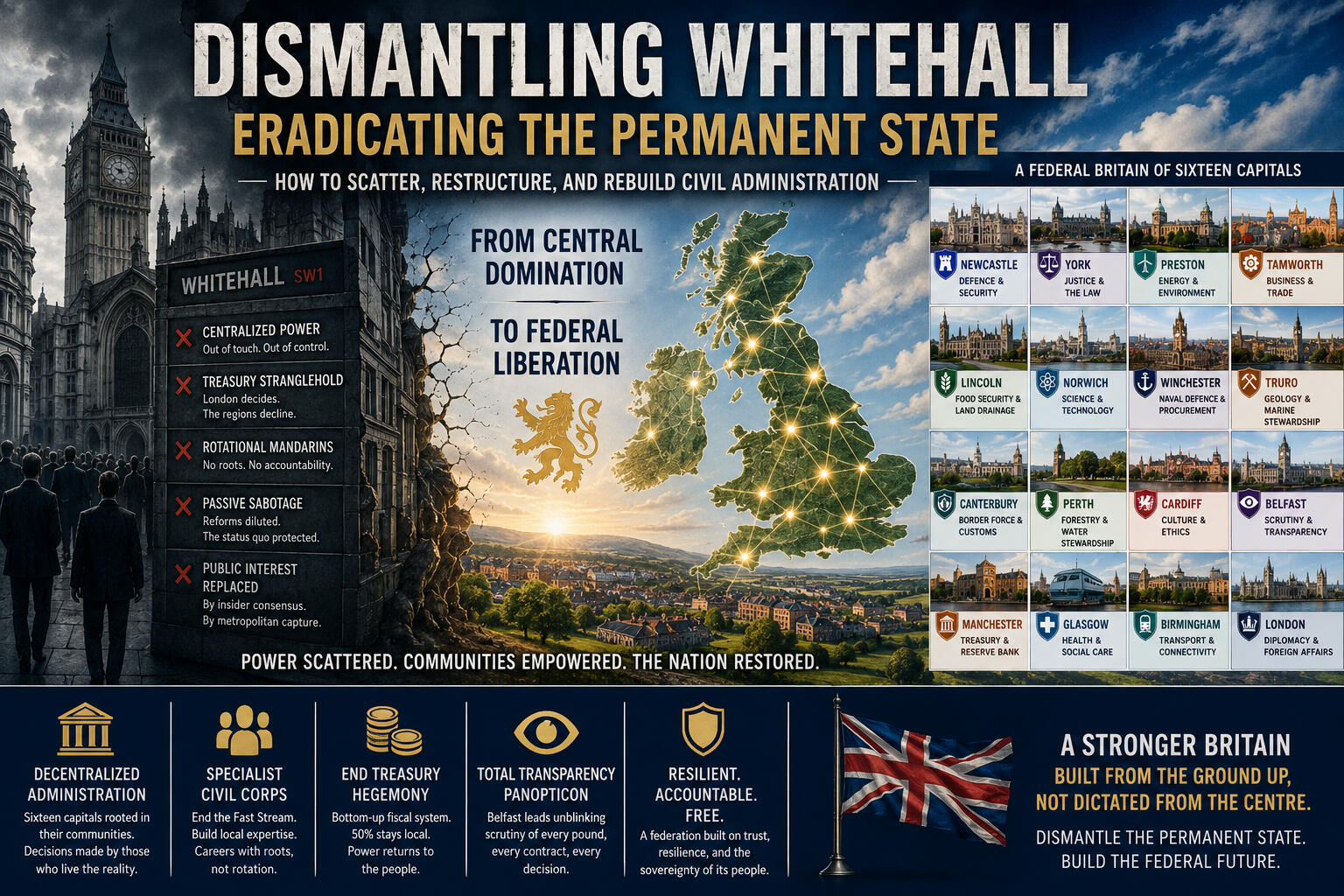
Whitehall is not simply a collection of government offices; it is a highly centralised administrative system with its own incentives, institutional memory, and concentration of power. This article argues that a federal Britain cannot survive while that machinery remains intact, and proposes replacing the unitary civil service with a geographically dispersed network of regional and metropolitan administrations. Departments are rooted where their work actually happens, the Treasury is relocated away from London, specialist expertise replaces perpetual bureaucratic rotation, and an independent scrutiny system makes government radically more transparent. The result is intended to be a state that is less concentrated, more locally knowledgeable, more resilient to failure, and ultimately more accountable to the people it serves.

The crippling of the unions had an immediate and devastating effect on the Labour Party, the supposed voice of the common man. Losing its traditional funding stream and core identity, the party undertook a fundamental transformation designed not to reclaim its socialist roots, but to court the very corporate interests that had bankrolled its rival’s success.
The current solvency crisis is not primarily one of mathematics; it is one of political cowardice driven by the disproportionate power of the elderly voting bloc. The system’s guaranteed collapse is inevitable because no politician dares to challenge the most politically powerful and reliable demographic: the elderly.
Ecological viability is not merely a policy goal; it is the foundational environmental right upon which the value of all other human rights depends. Without a viable environment—a stable atmosphere, uncontaminated resources, and predictable seasonal cycles—the Constitution becomes a ghost document—a historical testament to rights we can no longer afford to exercise. The time has come to elevate The Right to a Viable Environment to the status of supreme law