The scope of the UK’s pothole problem is staggering, growing year after year with an accelerating pace that local authorities are ill-equipped to address. The financial strain on both local government and the public has become immense, creating a repair backlog that threatens the integrity of the entire road network.
What was once a careful handover has become a frantic “dump and dash”—a ritual of negligence. The thud of a parcel hitting the ground on the other side of your fence, the sight of packages left exposed to the elements, and in a grim display of apathy, parcels abandoned in wheelie bins. The sight of a “Fragile” sticker on a package crumpled in a puddle is no longer shocking; it’s an expected outcome. This is a systemic issue, not a series of isolated incidents.
Ultimately, the Left-Right debate is an irrelevant argument about who should be in charge. The left and the right are simply two different groups vying for control of the same broken system, only further exacerbated by the fact that here in the UK the left are really the right by another name
This slow-motion fiscal cancer has metastasized across every critical function of the state. This is not a shortage of resources, but a shortage of foresight. The system privileges politicians seeking survival, budgets demanding cuts, and citizens paying the price. All so they can survive the next two-year budget cycle
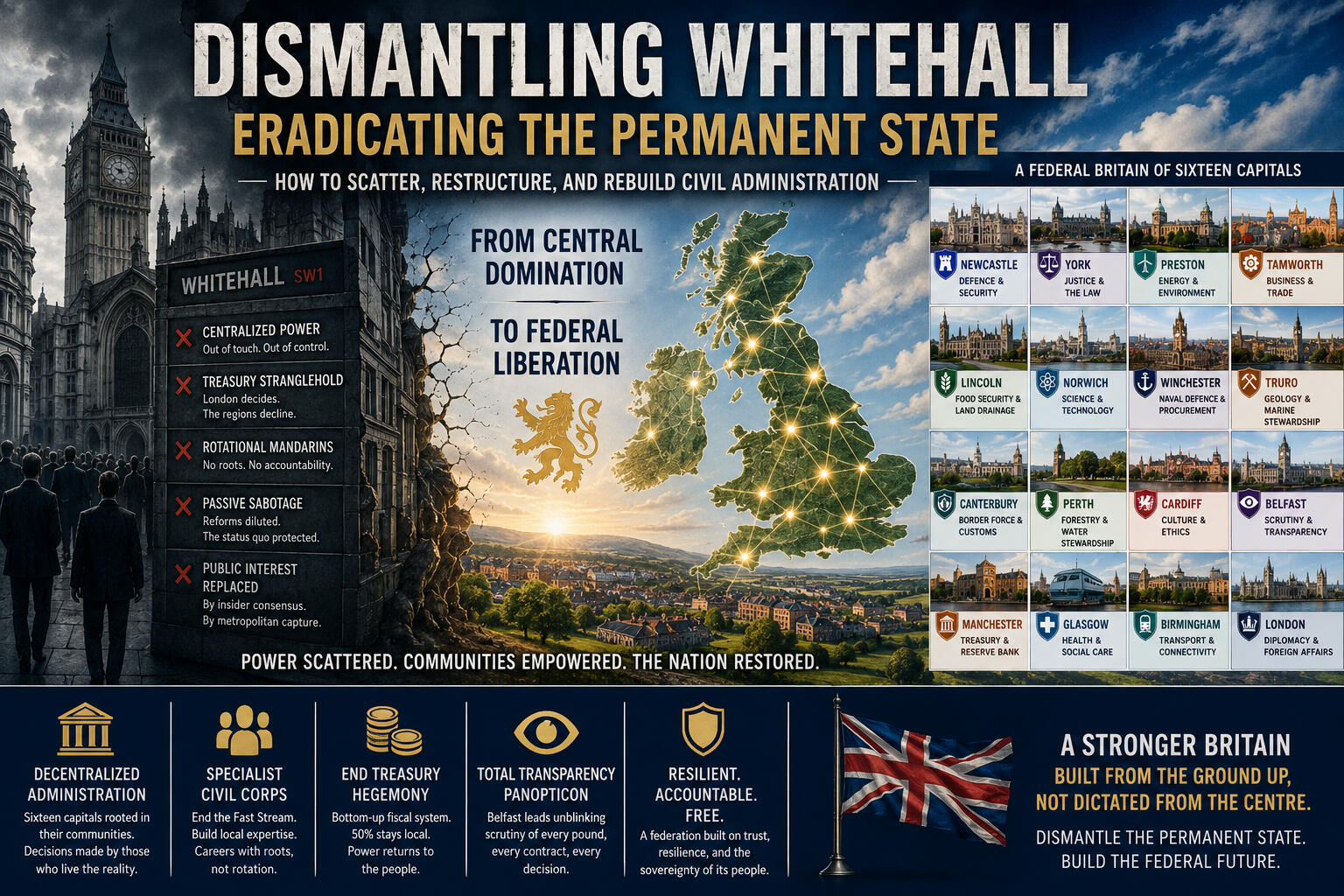
The time has come to complete the unfinished business of constitutional reform. We must move beyond piecemeal changes and build a new, fully elected upper chamber that is truly fit for the 21st century. This new chamber would not only provide a powerful democratic check on the House of Commons but would also serve as the beating heart of a federal Britain
Some counties, like Yorkshire, possess the identity, culture, and critical mass to stand as a region in its own right, with a distinct economic engine and a population larger than Scotland. Other counties would be at liberty to form clusters, with the consent of their populations, to create new county regions with a shared identity and governance.
Older workers currently occupying these exact roles were often hired with no qualifications at all; they walked into a local business, “shook hands, and got the job,” without an interview, without a CV and often without even having finished formal education. Now, corporations demand a Bachelor’s degree for a job that is considered “entry-level,”
The Pensana case is an irrefutable indictment of a system where short-term political inertia and geographic bias systematically override long-term national security and economic resilience. It is a clear example of the slow, self-wrought decline that results from mistaking a gesture for an investment, and a democracy’s inability to overcome its own structural failings.
Westminster, through its highly centralized model of governance, has adopted a set of behaviors that uncannily mirrors the “rules for rulers” outlined in the handbook. By controlling the flow of resources, selectively investing in infrastructure, and hollowing out local institutions, the UK government—regardless of which party is in power—is effectively propagating a dictatorial approach rather than upholding the free democracy it claims to represent.
The Golden Age of Piracy was a radical, self-governing alternative to the exploitative and life-threatening conditions of the British Royal Navy and merchant fleets. Life aboard a naval ship was brutal, with harsh discipline, low wages, and a high risk of death or injury with no compensation.